 Photos of recipes from the new book Tender Grassfed Barbecue
 Photos of recipes from the cookbook Tender Grassfed Meat

A Magnificent Roast — Grassfed and Fatty
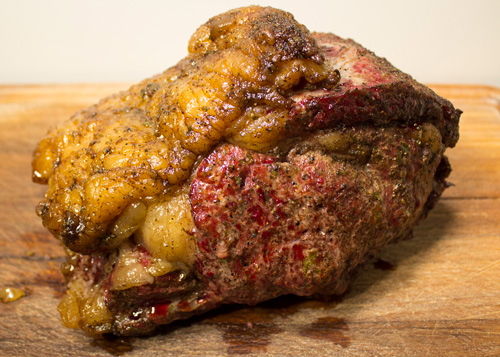
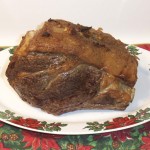
A magnificent grassfed prime rib.
By Stanley A. Fishman, author of Tender Grassfed Meat and Tender Grassfed Barbecue
Our ancestors prized the fat in meat. Humans have raised beef cattle on grass for thousands of years, and they always tried to raise them to be fatter. Incredible breeds were developed over the centuries, cattle that fattened well on good grass and provided tender, delicious, meat; full of the nutritional benefits of grassfed fat. This beef was prized and loved.
Then two events happened that denied most of us access to this wonderful meat.
The first, starting mainly after World War II, was the widespread adoption of fattening cattle on grain, starting out with corn grown by artificial fertilizer, then leading to the use of soybeans and other substances, and resulting in a system where most cattle were taken from the pasture and sent to a feedlot to be fattened with foods that were never part of their natural diet. This resulted in a change of the very composition of the fat of the animals, and a great decline in taste.
The second was the false belief, almost universally held to be true, that eating animal fat increased cholesterol levels in the blood, causing heart disease. We now know, from extensive research, that this was never true. But this false belief led to the demonization of all animal fat. Meat was routinely trimmed of all visible fat, and leaner meats were widely claimed to be healthier.
When I started eating grassfed beef, and learned how to cook it, I was amazed at how good it tasted, and how much better I felt after eating it. Yet I immediately ran into the problem that grassfed meat providers trimmed most if not all of the fat off the meat, and most tried to make a selling point of how lean their meat was.
This began a constant struggle to try to get grassfed meat with more fat in it, and more fat on it, a struggle that continues to this day. Throughout this period, I had one solid, superb meat supplier, and I was able to get fattier grassfed meat from them, and it was wonderful. Yet I was unable to get an old style grassfed roast, with a thick cap of its own glorious fat, and ample marbling. Until recently.
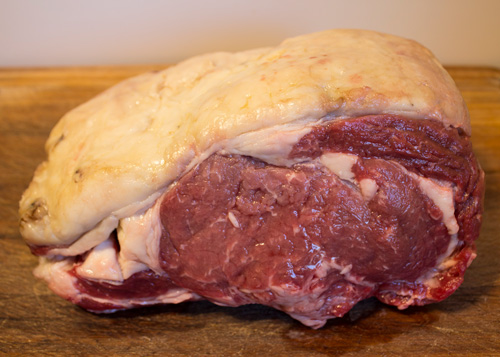
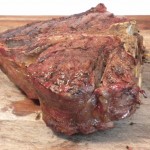
This raw grassfed prime rib has a thick fat cap that will flavor and tenderize the meat.
Note the beauty of the raw prime rib roast in the photo above. That is a magnificent piece of grassfed meat. The tiny steaks of white fat in the meat are called marbling, and the flavor and tenderness they provide to a roast when they melt into the meat has to be tasted to be understood. The thick cap of natural fat covering the roast is known as the fat cap, and it melts over and into the meat as it cooks, basting it, and making it even more tender and delicious, and preventing the meat from drying out.
This is a roast that our ancestors would have appreciated, the kind that was recommended and celebrated in older cookbooks.
The photo at the top of the page shows the same roast, after it was cooked, just prior to being carved and enjoyed. The photo shows the beauty of the roast, but it cannot recreate the wonderful aroma, the tenderness of the absolutely delicious meat, the feeling of joy and satisfaction as it was tasted. It felt so right, so familiar, somehow. The roast was marinated with a combination of four traditional ingredients, all of which helped bring out its superb natural flavor, and slow roasted on a pellet barbecue using oak as the wood. Very easy, very simple, utterly tender and delicious.
I recommend cooking a roast this fatty, medium rare (to around 130 degrees), rather than rare. This allows the fat to melt into the meat, which gives it that characteristic prime rib flavor and tenderness.
The success and popularity of the Ketogenic movement, which appreciates the value of good fat, is making fatty grassfed meat more popular.
One of the secrets of great cooking is to get great ingredients. This roast was obtained from my favorite meat supplier, U.S. Wellness Meats. If you want to try it, here is the link. Be sure to ask for a “high fat prime rib” in the Note section of your order.
I will not receive any compensation if you order this roast.
I am disclosing once again that I have a long and excellent relationship with U.S. Wellness Meats, going back eleven years. They were the first provider to sell me grassfed meat that I could make tender, and I have ordered regularly from them ever since. The founder of U.S. Wellness, John Wood, encouraged me to write my first grassfed cookbook, and bought a number of copies when it first came out, and sold and helped publicize the book. I am proud to call him my friend, and I have other friendships with some great people in the organization. They still sell both of my books, which they purchase from me.
That said, our relationship would never have been close if they had not provided me with so much excellent meat, over so many years. And the photos speak for themselves.
Real Food, Real Taste
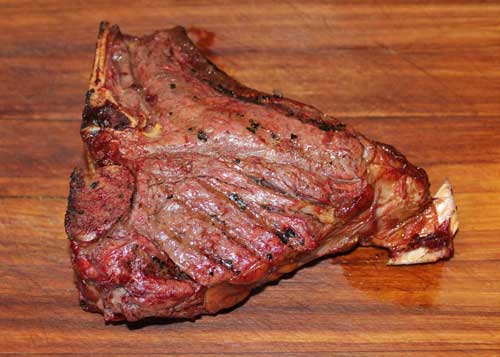
Grassfed Bison Porterhouse Steak
By Stanley A. Fishman, author of Tender Grassfed Meat and Tender Grassfed Barbecue
As part of a celebration, we were eating at a highly recommended steak house. Since this was a special occasion, I ordered a dry aged ribeye steak. Prime grade, which was supposed to be the very best. There had been so much hype and marketing for this steakhouse and this cut that I thought it would be worth breaking my habit of eating grassfed meat only. Just this once. Just on this special occasion.
The steak arrived. Despite the hype, it looked merely good, not great. And it did not smell like anything.
I took my first bite. It was amazing. Wonderful flavor, a hint of butter, tender enough, so delicious. I wanted more. I took the second bite and chewed. Nothing. Total bleh. Without the great taste of the first bite, the poor texture and mouth feel of the steak dominated, as did the weak, almost nonexistent flavor. Or rather, the absence of flavor. I did not even want to swallow it. But I did.
I was stunned. How could the first bite be so good, and the second bite be so, so nothing?
Was there something wrong with me? I tried a third bite. Even more bleh than the second. I tried the potato dish that came with the steak. It tasted good. On the first, second, and third bites. Then I took my fourth bite of the steak. Even more bleh, and I was starting to really dislike what taste there was.
There was nothing wrong with my taste, as the potato dish tasted good with every bite. It was the steak.
But why did the first bite taste so good?
Over the next few weeks, I frequently made grassfed beef steaks and roasts, and some grassfed bison roasts. Every bite was wonderful and satisfying, so much better than the highly touted steak I had at that steakhouse. And I felt much better after eating them.
On several occasions, I went to other highly recommended restaurants, and tried a variety of meat and seafood dishes. Time and time again, the first bite was wonderful, the second bite was bleh, and the whole disappointing experience repeated itself.
Then, we went to an old family favorite, a local restaurant which has been open since the eighties, when quality of food was very important to good restaurants. I had a grassfed T-bone steak. The first bite was absolutely wonderful, as was the second, the third, and every other bite, until the only thing left of the steak was a bare bone. I felt wonderful after eating it.
I finally understood, or at least I think I do. The first bite at the other restaurants was greatly improved by flavor enhancers, and other methods used to make the food taste much better than it actually was But my senses adjusted to the flavor enhancers, or whatever was used, and somehow ignored them, so the food tasted to me as it really tasted on the second bite, and later bites. The real food, the grassfed meats, tasted good to me on every bite because they really tasted good on their own, when skillfully prepared.
After eleven years of trying to eat only real foods, especially real meats, my body had learned to recognize them, and was no longer willing to accept the taste of flavor enhanced factory foods.
I have communicated with other people who have had similar experiences, and it is not just me.
My body is telling me what it wants, and what it does not want, and I will listen.
Thanksgiving Tips Collected Here
By Stanley A. Fishman, author of Tender Grassfed Meat and Tender Grassfed Barbecue

Here are links to the Thanksgiving tips that I gave in blog posts last year. (Each post below has links to the next tip and/or the last tip at the bottom.) Happy Thanksgiving!
Selecting the Turkey
Brining the Turkey
Stuffing the Turkey
Roasting the Turkey
Turkey Broth from Leftovers — Paleo, Primal, and Delicious
When It Comes to Food — Quality Matters
By Stanley A. Fishman, author of Tender Grassfed Meat and Tender Grassfed Barbecue
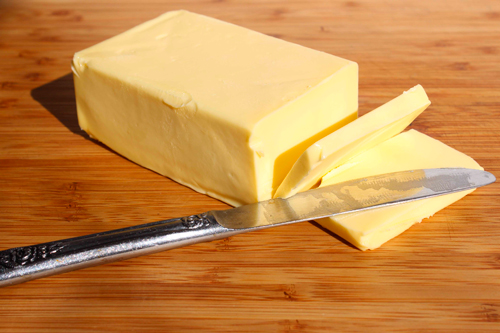
My favorite grassfed butter, the very best butter I have found.
Henri Charpentier was once the most famous chef in America. He was born in France and became an orphan at an early age. He grew up in poverty, became an apprentice in a restaurant, and literally cooked his way into becoming one of the most famous chefs in France. Charpentier moved to the United States and started a small restaurant in a rural area, which was patronized by some of the most wealthy, famous, and powerful Americans of the day, who would travel for many hours just to enjoy the wonderful food he cooked.
He published the Henri Charpentier Cookbook in 1945. In the book, Charpentier shared his most important cooking secret. The secret was very simple. He advised his readers to buy the very best butter they could afford.
He did use a great deal of high-quality butter in his cooking and in his cookbook.
When I first read this simple advice, I laughed at it. It seemed like a joke. Everybody knew that butter was butter, and all butter was the same. I was very mistaken, but I knew no better. Americans had been told for many years that our modern American food was all very good, and all pretty much the same. Trying to find and buy an especially good type of butter seemed both foolish and extravagant.
I have learned a lot over many years of cooking. One of the most important things I have learned is that some varieties of a particular food are of a much better quality than others. Using the best butter I can find in my cooking has made an enormous difference, both in taste and in nutrition. And this distinction applies not only to butter, but to every kind of food.
Our ancestors were obsessed with quality and were always trying to find the best quality food they could afford, and spent a lot of time and effort in doing so.
Some years ago, I used small amounts of a relatively expensive olive oil to marinate meats and achieved excellent results. Over the years, I started using less expensive olive oils, which were also organic and traditionally made.
Yesterday, I found myself thinking about the wonderful olive oil I used to use and bought some. I used a little bit as part of a marinade for some grassfed lamb. The meat came out so tender, with an intensity of flavor that was far beyond what I expected. The good oil had somehow brought out and intensified all the flavors in the dish, making it much better than it had been when I used the less expensive oil.
I now realize that Henri Charpentier was right. The quality of the ingredients is the most important part of cooking a great meal. The oil I used was certainly not the most expensive olive oil out there, but it was so much better than the others I had used. It changed the quality of the dish from good to excellent, and was worth the extra expense and effort.
Price is not the only indicator of quality. Something is not necessarily better just because it costs more. You will only know the quality of the food when you taste it and digest it.
I am convinced that there is a huge difference in quality in the foods that we can get, and it matters very much. Our ancestors knew that, and as with so many other things about food, they were right.
Putting the Marrow in the Bone Broth
By Stanley A. Fishman, author of Tender Grassfed Meat and Tender Grassfed Barbecue
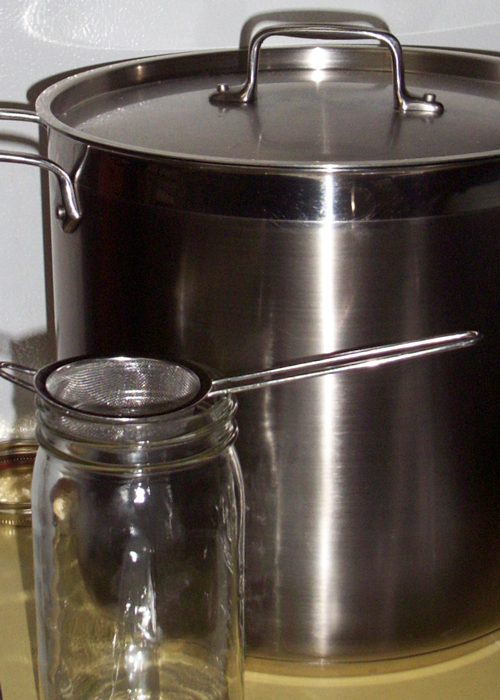
Bone broth equipment.
Bone marrow, the soft white substance inside bones, has been one of the most prized and valued traditional foods, not only for humans, but for animal predators.
Lions and other predators use their powerful jaws to crack open the bones of their prey, to get at the bone marrow. Most ancient cave dwelling sites have a pile of old bones, which have been split open to get at the bone marrow. Most cultures have traditional recipes for bone marrow, often adding cut bones to broth.
Modern research has shown that bone marrow contains many substances and nutrients that are very valuable, and can rebuild and revitalize various areas of the body, such as the bones and the blood.
Many of us who seek to follow the nutritional wisdom of our ancestors make bone broth, very often with marrow bones included. The bones are usually cut, so the marrow is exposed. I have made numerous bone broths, often with marrow bones. While all the broths felt good and revitalizing to me, I did not notice any real difference in broths that contained marrow bones, and broths that did not.
Until I changed the way I made it.
I have made bone marrow broth the new way exactly once, but the results have been amazing. I feel a great burst of energy and renewal as I drink it, a much stronger reaction than I usually get from drinking homemade broth. The taste is also different, more intense, and quite pleasant.
I used to make bone marrow broth by putting the cut bones in a pot, often with other bones and meat, and simmering it for a very long time, with added salt. But I have noticed that most of the marrow seems to stay within the bone itself, though in a cooked form.
Wild animals and the cave people were the inspiration for the change I made. They removed the marrow from the bones. What if I did the same?
So, using a small spoon, I carefully removed most of the marrow from the marrow bones, and placed it in the stock pot. Since the bones I purchase are already cut, this was not that hard, though I took some time, being careful not to break off tiny pieces of bone. The marrow resembled tubes of a soft white substance, which floated on the water once I added it to the broth.
I cooked the broth in the usual way, and all the marrow dissolved into the broth. As always, I carefully strained the broth through a fine sieve before consumption or storage to ensure that no little bone bits are in the strained broth.
The broth did taste different, more intense, but not unpleasant. But I did not mind the new taste, because the broth felt better, and was the most energizing and best feeling thing I have ever drunk.
I now understand why our ancestors prized the bone marrow so much, and I happily look forward to drinking it, every day. And I crave the wonderful new taste of the dissolved bone marrow, because my body has learned to love it!
Traditional Roast Potatoes
By Stanley A. Fishman, author of Tender Grassfed Meat and Tender Grassfed Barbecue

Delicious, traditional roast potatoes
When I was growing up, one of the most common side dishes we had, and perhaps the most popular, was roast potatoes. These potatoes roasted right in the pan with the meat or poultry, picking up great flavor from the drippings of the roast. They were crisp and caramelized on the outside, soft and tender on the inside, and absolutely delicious. And they went perfectly with the roast that flavored them.
Now, we usually make these potatoes whenever we have a roast, which is often, and we never tire of them. I thought for many years that just about all cooks made them.
I was greatly surprised to learn recently that many people have never even tasted these potatoes, which have been such a welcome and common presence at our table for so many years.
I think this is due in part to the demonization of fat, since these potatoes must be cooked and flavored with fat. Nevertheless, this side dish is so easy and so delicious that I would like to share my recipe, including a secret tip from my mother, with those who are interested in making them.
First, you need a roast. This can be any kind of beef, lamb, or pork roast. A turkey or a chicken also works. But ducks and geese give off too much fat for this method. A beef, lamb, or pork roast should have a nice fat cap. If the meat does not have a decent fat cap, you can cover it with butter, or beef tallow, or lard, or duck fat, or goose fat. The turkey or chicken must have the skin on, and should be also coated with butter or some kind good natural fat. The roast is cooked without a rack, placed fat side up in the case of meat, or breast side up in the case of poultry. You can place it on some vegetables, such as onion circles, which I often do, or directly on the pan. This recipe cannot work if a rack is used.
The potatoes I use are usually russet, though Yukon gold potatoes also work very well. I only use organic potatoes, as I try to avoid pesticides, and the flavor is much better.
The potatoes are peeled, and sliced into circles about one half inch thick. My mother’s secret, which I have also found in some very old cookbooks, is to place the peeled and sliced potatoes into a pan, cover them with water, add a little salt, and bring them to a rolling boil. They are then boiled for five minutes, no more, no less, then drained.
This secret might not sound like much, but it makes a huge difference.
A large roasting pan, not aluminum or non stick, is well greased with oil or butter, or lard, or any good animal fat.
The roast is placed in the center of the pan. No rack is used.
The potatoes are placed all around the roast, in the empty spaces. There is a great temptation to cram as many potato slices into the pan as possible, but the potatoes will be better if there is a little space between them, so they are not touching. I keep this space as small as possible.
The roast is cooked according to its recipe, and the potatoes are turned over once, when the roast has cooked for half the estimated cooking time.
The roast is basted with the drippings at least once, and preferably two or three times. This will add great flavor to the roast and the potatoes.
The potatoes are ready when the roast is, and should come out crusty but not hard or burned, and wonderfully soft inside, with an incredible caramelized flavor from the drippings and the spices used with the roast.
These potatoes are particularly wonderful with a prime rib beef roast, as there is a flavor that only prime rib has that gives them a special, wonderful taste. But they are also wonderful with other roasts.
This is a very old and traditional way to eat potatoes, and one I never tire of.
Curry Anything — A Great Meal from Leftovers
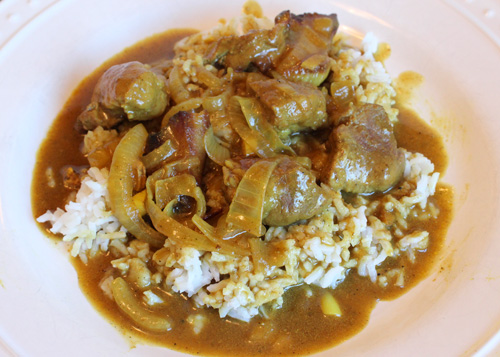
A delicious, easy curry.
By Stanley A. Fishman, author of Tender Grassfed Meat and Tender Grassfed Barbecue
I cook many kinds of meat, in many ways. Often there are leftovers, which I would dutifully place in the appropriate containers and put in the refrigerator. I would look at them in the refrigerator, from time to time, and decide there was not enough left to make a meal. Then, after enough time expired, I would throw them out.
At least that used to be my pattern. Now I use them to make delicious meals. As usual, the inspiration came from our ancestors. They would often combine different kinds of meat in the same dish, often with many different vegetables. It occurred to me that this could solve my problem of not having enough left over of a particular meat to make a meal. So I started combining them into stews and curries.
If I have small amounts of leftover beef, chicken, lamb, pork, or other meat, I will combine them. Since the meat has already been cooked, there is no need for marinating or browning, and the stews and curries cook very quickly. The curries are quicker to cook than the stews, so I make them more often.
I use the same recipe to cook leftover meats. It always turns out delicious, is ready in no more than 30 minutes, and is full of great nutrition. Here is the recipe:
Curry Anything
2 to 3 cups of leftover meat (such as beef, lamb, pork, chicken, turkey, or any or all of the above), sliced or chopped into small, thin pieces
4 tablespoons organic butter, (or organic ghee, or organic coconut oil)
1 large organic onion, peeled and sliced
3 large cloves organic garlic, peeled and sliced
A piece of organic fresh ginger, about 1 inch long and 1 inch thick, chopped into tiny pieces
3 or more tablespoons of the organic curry powder of your choice, (I use the organic curry powder sold by Mountain Rose Herbs)
2 tablespoons organic flour of your choice, (which can include non-grain flours such as almond flour)
1 1/4 cups homemade broth of your choice
2 tablespoons pure fish sauce, (I use Red Boat Fish Sauce, as I love its taste, traditional way of being made, and it makes me feel good when I eat it)
- Heat the fat in a heavy frying pan, preferably cast iron, over medium heat, until the fat bubbles. Add the onions, garlic, and ginger, and cook for 2 minutes, stirring occasionally. Add the curry powder and the flour, and mix with the vegetables in the pan.
- Add the broth and fish sauce, and stir until the mixture thickens, and starts to simmer. Add the meat and mix well. Bring the mixture back to a simmer, then reduce the heat to low, and cover the pan. Simmer covered for 25 minutes. Serve with the organic rice of your choice.
Is There a Hidden Nutrient in Barbeque?
By Stanley A. Fishman, author of Tender Grassfed Meat and Tender Grassfed Barbecue
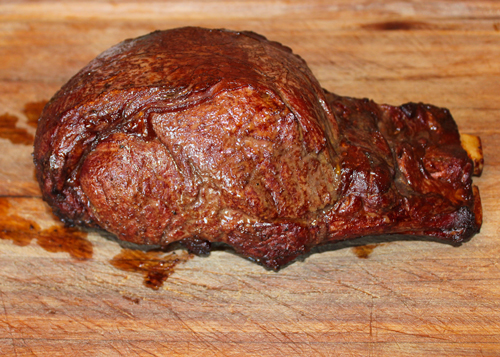
This magnificent prime rib, cooked in front of a hickory fire tasted even better than it looks.
We are now right in the middle of barbecue season, and I have cooked a lot of Que, and eaten a lot of Que.
And I must say, the more Que I have, the more I look forward to the next barbeque.
So far, I have enjoyed barbecued grassfed beef, including ribeyes, tri-tips, bone in strip loins, boneless strip loins, center cut shoulder roasts, beef back ribs, short ribs, flat iron steaks, sirloin tip roasts, sirloin steaks, the occasional porterhouse or prime rib or tenderloin, and more, and enjoyed them all.
I have also barbecued and enjoyed grassfed bone in lamb legs, boneless lamb legs, lamb shoulder, lamb shoulder chops, lamb ribs, rack of lamb, and some lamb loin chops, and enjoyed all of them as well.
And that does not even count the pork ribs, port roasts, pork chops, chicken in many forms and the rare but truly wonderful grassfed bison, which I have also cooked and enjoyed.
I never use gas, or factory charcoal briquets, or big flaming fires that char the meat. Like most of our ancestors, I use moderate to low fires of lump charcoal and wood, or just wood, and cook in front of the fire, not directly over it. The meat never chars or burns, but picks up the incredible flavor of oak, or hickory, or cherry, a deep smoky flavor that makes the tender meat taste so good that it is like nothing else. No other method of cooking excites me like this one. No other food aroma makes me so hungry just to smell it. And no other food makes me feel so good when I eat it
Does the wood have some kind of unknown nutrient that enters the food through the smoke? No scientific evidence I know of, but sometimes I think it must be true. Why else would it taste so good, be so satisfying, and leave me feeling content and wonderful?
Or maybe the smell and taste of meat cooked with wood smoke speaks to something very old and primordial, a vague yet powerful ancestral memory of countless meals cooked with fire and smoke, the oldest way of cooking. Something below the conscious mind, yet very real.
All I know for sure is that there is something about cooking barbeque that I truly love, including making and controlling the fire, the smell of the wood and roasting meat, even the sounds of the fire. And there is something about barbequed real meat that tastes better to me and satisfies me more than any other food.
Well, enough writing about it. Time to do it again, this time a big thick strip loin cooked in front of an oak fire. I am getting hungry just thinking about it.
The Magic of a Traditional Stew
By Stanley A. Fishman, author of Tender Grassfed Meat and Tender Grassfed Barbecue
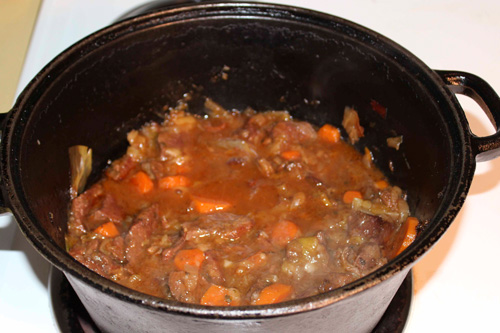
A rich traditional stew is good eating, loaded with nutrition.
Most traditional stews throughout the world have one thing in common. They were cooked until most of the vegetables were very soft, often disintegrating into the stew. The meat was also cooked right along with the vegetables, until it was very soft, and easy to chew. However, in more modern stews, the vegetables are usually cooked separately, so they remain in distinct pieces, and the vegetables are added to the meat only a few minutes before serving. This is considered to look better, and to preserve more of the nutrients in the vegetables. But our ancestors cooked everything together, and were fine with the vegetables disintegrating into the stew.
I made a couple of traditional stews this winter, and really enjoyed them on the cold, rainy days we have been having. They tasted wonderful, and warmed and renewed me, in a way that no modern stew ever did. I felt better while I ate them, and after I ate them.
Why the difference?
After some thought, I realized that the traditional stew, with its long-cooked ingredients melting into each other, is much easier to eat, and to digest. Since it is easier to eat and digest, that means that the nutrients in the stew are more easily absorbed and processed by our bodies. The long, slow cooking breaks down the components of the vegetables and meat, making them softer, often causing some of the vegetables to disintegrate into the gravy, with their precious nutrients. When the stew is eaten, the nutrients are right in the gravy, all broken down into a much more easily absorbed form.
It is true that cooking may reduce the amount of vitamin content in some vegetables, but vegetables are hard to digest and many people have trouble absorbing the nutrients. Cooking them in a traditional stew makes the remaining nutrients very easy to absorb, so you end up getting more nutrition.
This idea is supported by the tradition, in many lands, and throughout Europe, of feeding stews and broths to people who were recovering from sickness or physical injury. These kinds of foods were considered vital for recovery, because our ancestors knew, through knowledge passed down for thousands of years, that stews and broths helped people recover.
I usually add cabbage and onions to my stews, and they almost totally disintegrate into the stew by the time the cooking is over. The flavor they add is beyond wonderful. The other vegetables are very soft, partially disintegrated into the stew, and taste so good, flavored by all the ingredients.
I am sticking to traditional stews, every time.
Brisket Pot Roast for St. Patrick’s Day
By Stanley A. Fishman, author of Tender Grassfed Meat and Tender Grassfed Barbecue
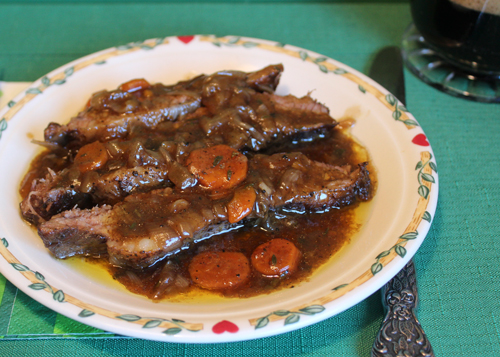 Most Americans think of corned beef and cabbage when it comes to a traditional Irish meal on St. Patrick’s Day. In Ireland itself, the selection is much more varied, including steak, prime rib roast, stew, or a pot roast made from fresh meat.
One of the glories of Irish cuisine is the magnificent quality of the native ingredients. Most of the beef raised in Ireland is still grassfed and grass-finished, and raised on small farms.
This recipe depends on the quality of the ingredients, and the better the ingredients, the better the dish.
The new beef brisket point introduced by U.S. Wellness Meats is perfect for this recipe. It has the deep beefy flavor of grassfed beef, and a nice fat cap that is needed for this recipe. It is important that all the other ingredients be of high quality as well, meaning organic (or the equivalent) vegetables and herbs, Guinness® stout from Ireland itself, and rich, deeply flavored grassfed beef broth. And it does have a bit of green in it, in the form of green onions and thyme.
This recipe is absolutely delicious and the meat is very tender and flavorful. Here’s the link to the recipe which is posted on the U.S. Wellness Meats blog: