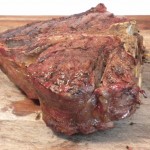
 Photos of recipes from the new book Tender Grassfed Barbecue
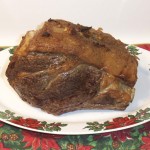 Photos of recipes from the cookbook Tender Grassfed Meat

Thanksgiving Tips Collected Here
By Stanley A. Fishman, author of Tender Grassfed Meat and Tender Grassfed Barbecue

Here are links to the Thanksgiving tips that I gave in blog posts last year. (Each post below has links to the next tip and/or the last tip at the bottom.) Happy Thanksgiving!
Selecting the Turkey
Brining the Turkey
Stuffing the Turkey
Roasting the Turkey
Turkey Broth from Leftovers — Paleo, Primal, and Delicious
When It Comes to Food — Quality Matters
By Stanley A. Fishman, author of Tender Grassfed Meat and Tender Grassfed Barbecue
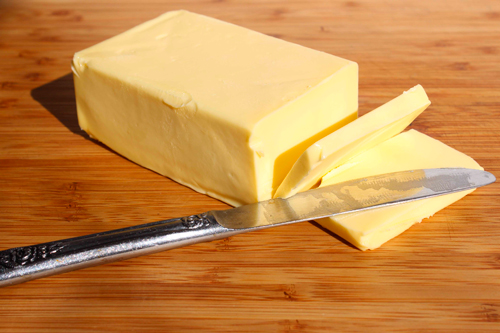
My favorite grassfed butter, the very best butter I have found.
Henri Charpentier was once the most famous chef in America. He was born in France and became an orphan at an early age. He grew up in poverty, became an apprentice in a restaurant, and literally cooked his way into becoming one of the most famous chefs in France. Charpentier moved to the United States and started a small restaurant in a rural area, which was patronized by some of the most wealthy, famous, and powerful Americans of the day, who would travel for many hours just to enjoy the wonderful food he cooked.
He published the Henri Charpentier Cookbook in 1945. In the book, Charpentier shared his most important cooking secret. The secret was very simple. He advised his readers to buy the very best butter they could afford.
He did use a great deal of high-quality butter in his cooking and in his cookbook.
When I first read this simple advice, I laughed at it. It seemed like a joke. Everybody knew that butter was butter, and all butter was the same. I was very mistaken, but I knew no better. Americans had been told for many years that our modern American food was all very good, and all pretty much the same. Trying to find and buy an especially good type of butter seemed both foolish and extravagant.
I have learned a lot over many years of cooking. One of the most important things I have learned is that some varieties of a particular food are of a much better quality than others. Using the best butter I can find in my cooking has made an enormous difference, both in taste and in nutrition. And this distinction applies not only to butter, but to every kind of food.
Our ancestors were obsessed with quality and were always trying to find the best quality food they could afford, and spent a lot of time and effort in doing so.
Some years ago, I used small amounts of a relatively expensive olive oil to marinate meats and achieved excellent results. Over the years, I started using less expensive olive oils, which were also organic and traditionally made.
Yesterday, I found myself thinking about the wonderful olive oil I used to use and bought some. I used a little bit as part of a marinade for some grassfed lamb. The meat came out so tender, with an intensity of flavor that was far beyond what I expected. The good oil had somehow brought out and intensified all the flavors in the dish, making it much better than it had been when I used the less expensive oil.
I now realize that Henri Charpentier was right. The quality of the ingredients is the most important part of cooking a great meal. The oil I used was certainly not the most expensive olive oil out there, but it was so much better than the others I had used. It changed the quality of the dish from good to excellent, and was worth the extra expense and effort.
Price is not the only indicator of quality. Something is not necessarily better just because it costs more. You will only know the quality of the food when you taste it and digest it.
I am convinced that there is a huge difference in quality in the foods that we can get, and it matters very much. Our ancestors knew that, and as with so many other things about food, they were right.
Putting the Marrow in the Bone Broth
By Stanley A. Fishman, author of Tender Grassfed Meat and Tender Grassfed Barbecue
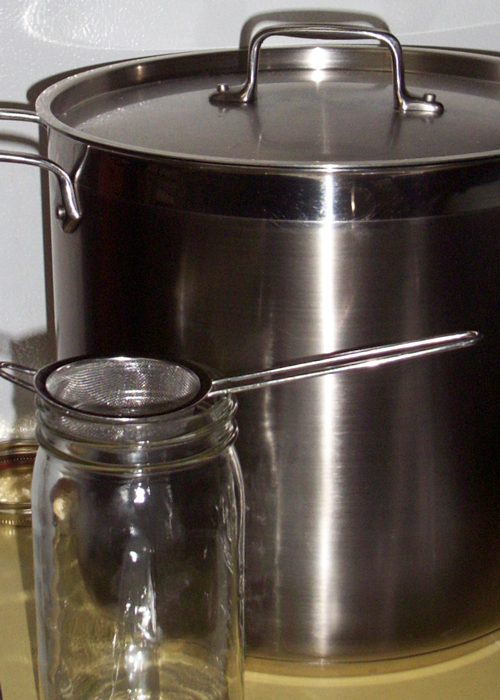
Bone broth equipment.
Bone marrow, the soft white substance inside bones, has been one of the most prized and valued traditional foods, not only for humans, but for animal predators.
Lions and other predators use their powerful jaws to crack open the bones of their prey, to get at the bone marrow. Most ancient cave dwelling sites have a pile of old bones, which have been split open to get at the bone marrow. Most cultures have traditional recipes for bone marrow, often adding cut bones to broth.
Modern research has shown that bone marrow contains many substances and nutrients that are very valuable, and can rebuild and revitalize various areas of the body, such as the bones and the blood.
Many of us who seek to follow the nutritional wisdom of our ancestors make bone broth, very often with marrow bones included. The bones are usually cut, so the marrow is exposed. I have made numerous bone broths, often with marrow bones. While all the broths felt good and revitalizing to me, I did not notice any real difference in broths that contained marrow bones, and broths that did not.
Until I changed the way I made it.
I have made bone marrow broth the new way exactly once, but the results have been amazing. I feel a great burst of energy and renewal as I drink it, a much stronger reaction than I usually get from drinking homemade broth. The taste is also different, more intense, and quite pleasant.
I used to make bone marrow broth by putting the cut bones in a pot, often with other bones and meat, and simmering it for a very long time, with added salt. But I have noticed that most of the marrow seems to stay within the bone itself, though in a cooked form.
Wild animals and the cave people were the inspiration for the change I made. They removed the marrow from the bones. What if I did the same?
So, using a small spoon, I carefully removed most of the marrow from the marrow bones, and placed it in the stock pot. Since the bones I purchase are already cut, this was not that hard, though I took some time, being careful not to break off tiny pieces of bone. The marrow resembled tubes of a soft white substance, which floated on the water once I added it to the broth.
I cooked the broth in the usual way, and all the marrow dissolved into the broth. As always, I carefully strained the broth through a fine sieve before consumption or storage to ensure that no little bone bits are in the strained broth.
The broth did taste different, more intense, but not unpleasant. But I did not mind the new taste, because the broth felt better, and was the most energizing and best feeling thing I have ever drunk.
I now understand why our ancestors prized the bone marrow so much, and I happily look forward to drinking it, every day. And I crave the wonderful new taste of the dissolved bone marrow, because my body has learned to love it!
Saving a Heritage Ham
By Stanley A. Fishman, author of Tender Grassfed Meat and Tender Grassfed Barbecue
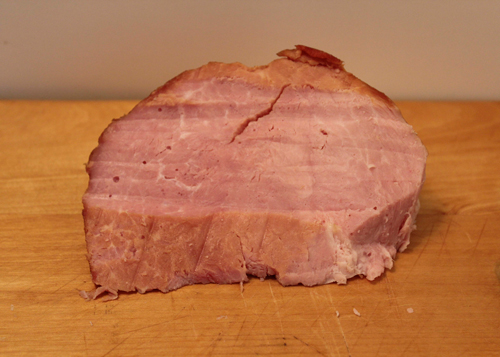
Notice the smoke ring around the edges of the heritage ham, after I marinated it and smoked it with pork fat.
The marketing was effective, I must admit. It even convinced me. A large boneless ham, raised on a small farm, from a heritage breed, cured in a traditional manner, smoked over hickory wood. And at a bargain price! The ham was fully cooked, which meant I could reheat it slowly in a low oven. Easy.
When the ham arrived, and was thawed, I started to take off the reddish brown wrap. As I started to remove it, I realized that the wrap was clear. The ham itself was covered with a dried coating, reddish brown in color, which had the consistency of sawdust glued together. Netting lines were deeply sunk all over the ham, from the netting that was used when it was hung to smoke.
I began to realize that the coating around the ham was the ham itself, what the outside of the roast had turned into, with not a single shred of fat in evidence. In mounting horror, I came to realize that all fat had been trimmed off the ham before smoking. With no fat to keep it moist, the ham had dried out in the smoking process, and lost most of its moisture. I stuck a fork in the ham, it met a lot of resistance. The meat was tough.
I sliced off a small outside piece of the ham and tasted it. The outside meat tasted terrible, with a horrid texture of sawdust. The interior meat was dry, so dry. Hardly any smoke flavor. Chewy, not tender at all. Not good. But there was a hint of a good pork flavor in there.
My family was expecting a nice meal. I decided to save the ham.
A plan was needed. I decided to cover the ham in organic apple juice, and marinate it for a few hours. This should add moisture and flavor. Then, I would add fat and heat it slowly in front of a smoky barbecue fire, at very low heat. This would add the smoke flavor it should have had. And I would restore the fat to the meat, by putting some sliced pork fat from another roast over the top of the ham.
I did not know if this would work, but I was going to give it my best.
But first, that sawdust-like outer coating had to be trimmed off and discarded. I took a sharp knife and trimmed the whole thing, getting off every scrap of the outside. I placed the ham in a glass bowl, poured the apple juice over it, and set it to marinate.
A couple of hours later, I stated a barbecue fire, using some hickory. I brought the temperature up to about 225 degrees. I placed the ham on a rack in a pan, covered the top with sliced pork fat, and set it to smoke. Several hours later, I boiled down the apple juice used for the marinade, until three-quarters of the liquid was gone, and used it to baste the ham occasionally. I was encouraged when I stuck a fork into the meat—it felt much more tender than before. I continued cooking until the roast had been reheated.
Then I started slicing it in the dining room. The knife glided easily through the tender meat. There was a wonderful wood smoke smell. The ham was moist, tender, and so delicious that it was hard to stop eating it. A disaster had become a wonderful meal. The inherent wonderful flavor of the heritage pork had been unlocked deliciously, once fat and moisture had been restored.
This post is part of Fat Tuesday blog carnival.
A Great Simple Grassfed Steak
By Stanley A. Fishman, author of Tender Grassfed Meat and Tender Grassfed Barbecue

U.S. Wellness Meats Delmonico steak. (Used with permission of U.S. Wellness Meats.)
Sometimes the very best food is simple, and easy to prepare. Complex, difficult recipes with dozens of ingredients, and difficult methods may be impressive, but the results are often disappointing, and hardly anyone will actually make them. When you have great meat, simple is best.
This old truth was brought home to me this Valentine’s Day, when two magnificent Delmonico steaks from U.S. Wellness Meats gave us an incredible meal, so good that no fancy recipe could even come close, in my opinion.
Good, Real Meat comes with Its Own Great Taste
There is an old saying, going back all the way to the Middle Ages:
“God gives us great meat, the devil gives us cooks.”
This saying referred to the fact that truly great meat has a wonderful flavor, texture and tenderness of its own, which is often ruined or diminished when cooks do too much to it. A few simple ingredients and the right technique, combined in a way that brings out, rather than overwhelms the natural flavor of great grassfed meat, is ideal. And it can be very simple and quick to cook.
The Meat
The meat is the most important part of cooking a great steak. There are many cuts of meat that used to be popular in the United States that are almost unknown today, which is a shame. You never see a pin bone sirloin steak anymore, but they used to be very popular. A bone in New York steak, sometimes called Delmonico, after the first fancy restaurant to become famous in the United States, is also very hard to find. Fortunately, U.S. Wellness Meats, which sells great grassfed meat online, carries a grassfed version of this cut, with the wonderful, flavor-giving bone. The meat is grassfed, just like meat was fed in the nineteenth century, when Delmonico steak was created. I chose this for our Valentine’s meal.
Why did I choose a bone in steak? The bone in this cut gives incredible flavor, as substances from the bone are released into the meat during the cooking. No spice, condiment, or oil can provide flavor like this.
The Method
The steaks looked so good when they arrived, even frozen, that I decided to prepare them using the simplest of three recipes for Delmonico steak contained in my first cookbook, Tender Grassfed Meat, on page 85. (This recipe can be made with a bone in or boneless steak.) The recipe contains only four ingredients, besides the steak. I knew these ingredients and this method would bring out the natural flavor of the steaks, not overwhelm it.
I thawed the steaks, and let them marinate for a few hours in a single, traditional ingredient. I added the other simple ingredients, melted some butter in a pan, and cooked them.
Cooking time was exactly eight minutes. That was all.
We were rewarded with a steak so good, so flavorful, so tender, that I would not trade it for the most expensive Kobe beef on the planet, cooked at the world’s top steakhouse.
The bone and the fat in the nicely marbled meat created so much beefy flavor, it was so tender, and the simple traditional ingredients brought out the magnificent real taste of the grassfed meat, a taste all the spices and condiments in the world could never create, could never equal.
That simple, easily cooked steak, was one of the best I ever had.
This post is part of Fat Tuesday, Real Food Wednesday and Fight Back Friday blog carnivals.
Why I Prefer Traditional Foods and Cooking
By Stanley A. Fishman, author of Tender Grassfed Meat and Tender Grassfed Barbecue

A traditional stove.
I was asked why I keep looking to the past for cooking inspiration. Modern technology and food science has developed faster and more efficient ways of raising and cooking food, innovations that are supposed to make everything better. Preserving food with chemicals prevents it from spoiling, and being wasted. Science has invented ways of extracting oil from plants that never were able to produce oil before, such as soy and corn. Scientific ways of raising cattle, with genetics, drugs, hormones, and feedlots, which cut the time it takes to bring a steer to market in half. And so many other new ways of doing things, that make the food traditions of the past obsolete.
I see it differently. Speed, efficiency, and innovation do not necessarily make food better. In fact, they often make it much worse, in my experience. These innovations are designed for profit, not for taste or nutrition.
And, to me, nutrition and taste are by far the most important aspects of food. Our ancestors also valued nutrition and taste above all. The food traditions of our ancestors have been passed down for hundreds and thousands of years, tested by every generation that used them. They became traditions because they enhanced nutrition and taste, and because they worked.
Traditional Foods vs. Modern Foods
Modern foods, grown and raised with a heavy dose of chemical fertilizers and pesticides, hormones, genetic modification, and feedlots, preserved through radiation and chemical preservatives, often flavored by chemicals, and designed for long shelf life and profit, are very different from the foods of our ancestors.
The traditional foods of humanity were developed over time, and eaten over many generations, so the ability to use and process these foods effectively was part of our ancestral heritage. These foods required rich soil, full of nutrients, to grow in; or rich pastures, also full of nutrients. Seafood was almost universally wild, with the nutrients of nature. Fertilizers and pest control methods were natural, using the products of nature, not a lab. These foods had a density and quality of nutrients that is rarely found today. And the wonderful natural taste of these foods, from nature, was much better than the taste of the factory foods used today.
Traditional foods were developed over many generations, raised in accordance with the laws of nature. They became traditional foods because they gave great nutrition to people, generation after generation.
Modern factory foods are a product of human technology, not nature. They have a very short history of use, and are developed for long shelf life and profit, not nutrition or taste.
I prefer to eat traditional foods, and am much healthier and happier when I do so.
Traditional Cooking vs. Modern Cooking
Modern cooking methods have been developed for speed, ease, and convenience. They have also been developed to enable people to cook factory foods, which are very different from traditional foods, and must often be cooked differently. Modern cooking equipment often uses methods that have never been used before in history, cookware from modern metals such as aluminum, non-stick cookware, and many other such innovations.
Traditional cooking methods consist of ways of preparing and combining foods that have been passed down from generation to generation, often going back thousands of years, often being slightly modified over time, yet essentially the same. They use the same cooking implements and techniques that humanity has used for thousands of years, many of which can easily be reproduced in an easier form by more modern methods. For example, an ordinary electric oven can bake and roast in much the same way as an ancient wood fire, especially when the temperatures are adjusted to mimic the temperature cycle of a fire burning down. Some techniques, such as frying meat in butter in a heavy cast iron pan, are essentially identical.
My books are devoted to recreating food traditions in a modern kitchen, especially the cooking of grassfed meat, and doing it the easy way.
I prefer traditional foods cooked in a traditional way, because it has been so much better for me in so many ways, and because it tastes so much better with an almost infinite number of time tested dishes to try and enjoy.
This post is part of Fat Tuesday, Real Food Wednesday and Fight Back Friday blog carnivals.
When It Comes to Real Food, Simple and Traditional Tastes Best
By Stanley A. Fishman, author of Tender Grassfed Meat and Tender Grassfed Barbecue
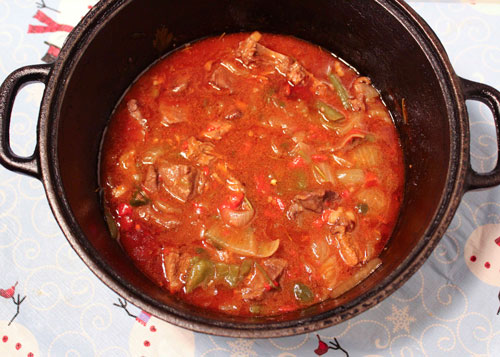
A traditional winter stew of grassfed meat and organic vegetables tastes wonderful.
Many people believe that good cooking is a mystery, one that can only be solved by celebrity chefs using arcane ingredients and complex methods. These TV chefs often use new methods and combinations that have been invented by the chefs, who gets praised for their innovation. High-tech modern products like meat glue are often used by such chefs.
I believe that simple recipes, using real food such as grassfed meat and organic traditional vegetables, using traditional food combinations, and traditional methods, prepared by ordinary people, taste the best.
I believe that cooking should be easy, not complex and difficult.
I am inspired by the quality and benefits of grassfed meat and real food, with their wonderful natural flavors. I am inspired by the ingenious simplicity of traditional cooking, which often uses just a few ingredients, simply combined and prepared, to produce outstanding, healthy food. These flavor combinations became traditional because they are really good. Many of these traditions are being lost, and I am honored to help preserve some of them in my cookbooks.
I contend that the best grassfed meat and real food is simple, using traditional methods, traditional ingredients, and easy recipes. When you have great ingredients, their wonderful natural taste should come out.
With Real Food — Simple Is Better
When I wrote my two cookbooks, Tender Grassfed Meat and Tender Grassfed Barbecue, I had several goals. One of the most important was to make them simple, and easy to use. Another goal was to provide recipes that were absolutely delicious. A third goal was to create recipes that people would actually make.
These three goals are not contradictory, if you are using grassfed meat and real food. The quality of these foods from nature is so high that the food itself provides most of the flavor. In fact, I contend that grassfed meat and real food are the best when prepared simply with traditional methods and ingredients. You can have a wonderful dish with just a few ingredients, if they are of the highest quality, and carefully combined. When you use only a few ingredients, all are important and changing even one of them can have a dramatic effect on the taste of the dish.
Real food ingredients have so much natural flavor and goodness that they are at their best when made simply, so that their wonderful natural flavor can come out.
Then, there is the simple fact that complex recipes, with dozens of ingredients, and difficult, complex techniques, are much harder and take much more effort and time to make. Often complex recipes fail, for any of a number of reasons. Usually, complex recipes are read, admired, and never made.
I want my cooking to be easy and simple, and delicious. I wrote these books for the ordinary person, because I wanted them to have ways to cook tender grassfed meat that were not only delicious, but easy. I wanted my recipes to be used, and enjoyed.
I did not write these books for critical acclaim, but to help people make delicious grassfed meat, the easy way.
In fact, I admit it, I prefer to make easy meals! It is not only easier, it is more fun!
This post is part of Fat Tuesday, Real Food Wednesday and Fight Back Friday blog carnivals.
A Magnificent Christmas Roast
By Stanley A. Fishman, author of Tender Grassfed Meat and Tender Grassfed Barbecue
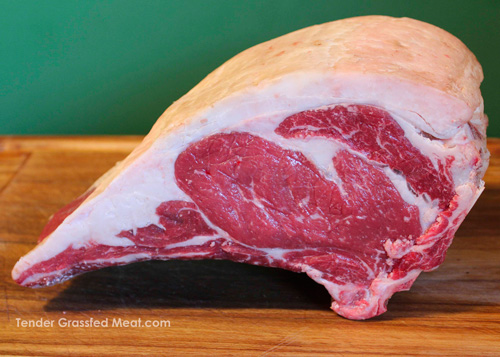
A magnificent grassfed prime rib with a great fat cap and marbling.
Our favorite holiday roast is a grassfed prime rib, with a nice thick fat cap, plenty of nice marbling in the meat, resting solidly on its own bones. It is not easy to find such a roast, but we hit the jackpot this year.
They say a picture is worth a thousand words, and the above picture says it all.
This prime rib is one the best I have ever seen.
Perfectly balanced on a strong rack of bones. Covered with a thick layer of its own flavor-giving fat.
Nicely marbled with small flecks of grassfed fat.
A beautiful color.
And there are even more reasons that I know this roast will be something special. Late last week, we had a grassfed shoulder roast picked up from a local market. The meat was beautiful, full of perfect marbling. It was incredibly tender and flavorful. I knew that the butcher had happened upon a truly remarkable steer.
The next day, I called the butcher up and asked if he could sell me a prime rib from the same animal. Turns out that he could. I showed up at the market, and politely called out my preferences as he cut the roast. He left all the fat on, which was my biggest concern. Due to the demonization of fat, most butchers will trim all the fat off a roast without even thinking of it. A very bad decision, because the fat contains most of the flavor, and all of the fat soluble vitamins and nutrients. And the fat itself, crisp and brown when the roast is done, is absolutely delicious and warming.
Not to worry, this butcher knew his stuff and happily complied with my request.
This is the old way of buying a special roast, where you know and trust the seller, know where the meat comes from, and carefully select the roast, even specifying the animal it comes from, and the way it is cut and trimmed. This is the way most humans have done it for most of time. Not at all like picking up a foam package in the supermarket.
Now that we have our roast, the planning for our Christmas dinner is complete. Here is the menu:
Roast Prime Rib of Beef: Lightly seasoned with herbs, pepper, garlic, and just a little salt, added at the last minute.
Roast Potatoes and Carrots: These will be roasted in the same pan as the roast. There will be no rack, as the bones make a perfect rack, and this allows us to place these vegetables in the pan, where they will become brown, crusty, sweet, flavored with the unique flavor of prime rib fat.
Sautéed Mushrooms: Cooked with plenty of butter and a bit of truffle oil, until browned and caramelized, with amazing flavor.
Yorkshire Pudding: Baked in the old style, made with pan drippings, the same magnificent beef fat
European Cabbage: From page 206 of Tender Grassfed Meat, onion, cabbage, and apple slices, cooked to perfection with bacon, in bacon fat.
Dessert? I doubt anyone will have room.
I want to wish all a very happy holiday season.
And, if you celebrate it, a very Merry Christmas!
This post is part of Real Food Wednesday and Fight Back Friday blog carnivals.
This Thanksgiving, Cook It Yourself
By Stanley A. Fishman, author of Tender Grassfed Meat and Tender Grassfed Barbecue

The centerpiece of the traditional Thanksgiving feast.
Thanksgiving gets a great deal of attention every year. For many, it is a time for families to see each other over a large traditional meal. Thanksgiving is the American feast. I like the idea of being thankful for the good things in my life. I happen to love the tradition, and to love eating the old favorites, prepared from real food. Yet I must confess something. I also love to cook the Thanksgiving feast.
Yes, it is a lot of work. Especially when you add the trimmings, such as homemade stuffing and real gravy, made with fresh broth and the magnificent turkey drippings. But to see the joy it brings to those who eat it-that is truly fulfilling. And chances are that your work will be very much appreciated.
And I want to confess something else. It is not that complicated. If you get real ingredients, even average cooking skills will result in a wonderful meal. I make a turkey, a stuffing, roast some vegetables in the pan with the turkey, roast some sweet potatoes on the side, make some simple boiled vegetables, and a wonderful gravy from the drippings. None of these items are difficult to prepare. It is just that there are a lot of them, and some are time consuming. The solution is planning and organization.
I plan the cooking of each dish, organize the ingredients, start early in the morning, and it always goes well. And the smell of the roasting turkey, lovingly basted with butter, is just magnificent.
Often, you can also get family members and friends to help with some of the tasks, and it can become a fun project, with a result that everyone will enjoy.
It has become common for supermarkets to offer people a full Thanksgiving meal, which just needs to be reheated, for a large amount of money. I am certain that no reheated meal from a store can possibly compete with a home cooked meal of real food. Food prepared for people you love or like, with love, has a special quality all its own.
After the feast, turkey leftovers are considered a problem by many people. Not me. Here is a link to a recipe for the turkey broth I make after every Thanksgiving, which uses those leftovers to create a wonderful traditional broth:
Turkey Broth from Leftovers — Paleo, Primal, and Delicious
Happy Thanksgiving! May you and yours eat well!
This post is part of Real Food Wednesday blog carnival.
Beyond Broth—European Peasant Soup
By Stanley A. Fishman, author of Tender Grassfed Meat and Tender Grassfed Barbecue
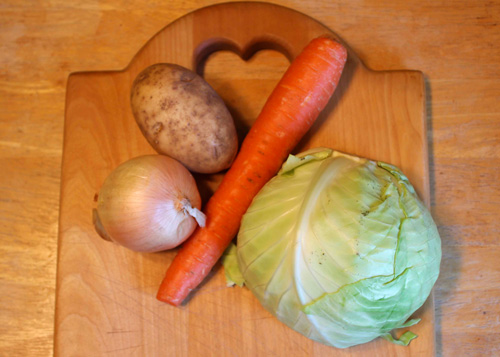
Classic European root vegetables for soup.
As I continue to write and research my upcoming book on traditional cooking, I kept running into the same fact. The use of homemade broth was universal across traditional Europe. This kind of broth, made from the bones, sinews, and meat scraps of pastured animals, and simmered slowly for a long time, at least twelve hours, is a nutritional powerhouse of minerals and other nutrients.
Yet I found something else. While this broth was often heated and sipped by itself, it was common to add other ingredients to make it into a soup. The variety of these soups was almost endless, yet certain ingredients were used over and over. These ingredients were used from Spain to Russia, and everywhere in between. These ingredients were always shredded or cut very small, in the traditional soups.
Since I believe that our ancestors combined ingredients for nutritional reasons, I decided to make a soup out of homemade broth and these widely used ingredients. I did so last night, to fend off the cold of an approaching winter, and to strengthen a body that was fighting something off. I was lucky, and feel that I found something so beneficial that it goes beyond broth in its benefits. The type of soup that European peasants made for themselves, to extract every bit of nutrition from the food they were able to get.
The Search
I have many traditional cookbooks. I have collected these books for over thirty years, and I have so many I am embarrassed to give the actual number. I began searching these books for soup recipes using these ingredients. I came across so many recipes that I could not decide, and they were all blending together in my head and thought. So I decided to go with the flow, and follow the thought I was having. A recipe began to form in my mind.
The Ingredients
Cabbage. Finely shredded cabbage was used in these kind of soups almost everywhere in Europe. I had learned that cabbage, both as sauerkraut and fresh cabbage, was heavily used in winter, and in much of the rest of the year. Fresh cabbage will keep a long time in a traditional root cellar, in cool or cold weather.
Carrots. Finely chopped carrots were another common ingredient. Carrots were also a universal ingredient of these types of soups.
Onion. The onion, valued since the days of ancient Egypt, was another universal ingredient. Except that the finely chopped onions were usually sautéed in some kind of animal fat as the first step in making the soup.
Fat. These soups almost always had some kind of fat that was used to sauté the onion, either bacon, or chicken fat, or butter, or salt pork, or ham fat, or olive oil, or others, depending on what was available.
Potato. The use of the potato in these soups was also almost universal. Potatoes were not introduced to Europe until the seventeenth century, at which point they replaced the previously ubiquitous turnip.
Salt and Pepper. Used by almost everyone to season the soup. Everyone had salt, and pepper was also common, though often not available for the poorer families.
The Cooking
I noticed that everyone cut these vegetables very small, shredding them or even cutting them into pieces the size of threads. I decided to settle for finely chopped vegetables.
I sautéed the onion in a medium sized saucepan with three tablespoons of butter. I then added a quart of homemade beef broth, cabbage, carrot, and a small potato, all finely chopped. I brought the mixture to a simmer, covered the pot, and simmered it for twenty minutes. The aroma of this soup, when I opened the lid, was fantastic.
The Eating
The soup was placed in large bowls. It was very hot, temperature wise, and we sipped it slowly. We added salt and pepper to taste. It was wonderful, nourishing, filling, warming. It was very filling. In fact, I felt that I was filling my body with easily absorbed nutrients, and I began to feel very good. By the time I had finished a bowl of soup, I felt very satisfied, totally warm, and healthy. The last traces of whatever illness I was fighting off disappeared. I woke this morning feeling completely fine, and immediately got to work on this post.
Our ancestors knew how to combine foods, how to get the nutrients into their bodies in beneficial combinations. Traditional cooking is not only delicious, but nourishing.
This post is part of Real Food Wednesday and Fight Back Friday blog carnivals.
Next Page »