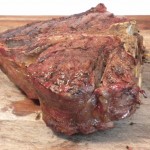
 Photos of recipes from the new book Tender Grassfed Barbecue
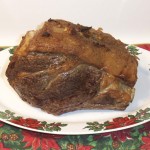 Photos of recipes from the cookbook Tender Grassfed Meat

Call It Medical, Not Mediterranean
By Stanley A. Fishman, author of Tender Grassfed Meat
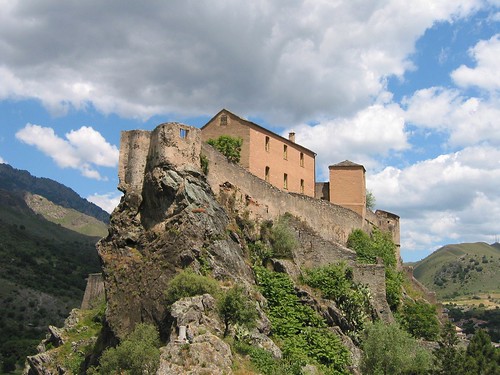
 photo credit: Roby Ferrari
Most medical institutions, and organizations recommend what they call the “Mediterranean diet†as ideal for human health. There is no denying that many of the European peoples living on the Mediterranean are healthier than Americans, though that is not much of an accomplishment, given how much factory food is eaten here.
The problem is that the “Mediterranean diet†pushed by the medical establishment has almost nothing to do with the real diet of the European peoples who live on the Mediterranean.
The “Mediterranean diet†recommended by the medical industry is very similar to the horrid “food pyramid†advocated by our government (though there are a few differences). The real Mediterranean diet had nothing in common with the food pyramid.
Contrary to the propaganda, the healthy peoples of the Mediterranean prized fatty pork, lamb, and goat, ate large quantities of unpasteurized full-fat cheese and milk, made heavy use of salted fish and brined vegetables, salty and fatty sausages, used butter and pork lard copiously in their traditional recipes, looked down on whole grains, ate small quantities of pasta as a side dish, hunted wild game such as rabbits and small birds, often went without vegetables, and generally ate as much saturated animal fat as they could get their hands on.
What Is the “Mediterranean Diet�
There are a number of European countries and several large islands that border the Mediterranean Sea, including, Spain, Italy, France, Croatia, Serbia, Greece, Crete, Corsica, Malta, Sardinia, and Sicily. I have studied the traditional cuisines of all these countries, including their Mediterranean regions. While each cuisine is unique, they do have a lot of common characteristics.
The Medical establishment claims that the traditional diets of the Mediterranean peoples had the following characteristics:
- Low salt
- Low fat, rejecting animal fats in favor of fats like olive oil and canola oil
- Ate red meat in tiny portions, only a couple times a month
- Ate mostly fruits, vegetables, legumes, whole grains
- Ate fish at least twice a week
- Avoided all saturated fats
- Ate 9 or more servings of fresh fruits and vegetables a day
Basically, none of these characteristics are accurate.
Mediterranean Peoples Ate Lots of Saturated Animal Fats
Almost every peasant kept a small herd of goats, or sheep. These animals were raised mostly for their milk, which was drunk raw, made into curds, made into a huge variety of full-fat cheeses, and widely used in cooking. The milk was unpasteurized and always full-fat. These dairy products were a huge part of their diet. The meat prized by the Mediterranean people was not lean, but fatty, consisting mostly of pork, lamb, and goat. Butter and lard were widely used in cooking, along with olive oil. While olive oil was widely used, it was used in addition to, not instead of animal fats. Canola oil was unknown, not even existing until it was invented in the late 20th century.
Mediterranean Peoples Ate Lots of Salt
Salting food was the main way of preserving food, given the warm climate, and the Mediterranean peoples were masters of salting fish, cheeses, and meat. They had hundreds of traditional recipes for meat sausages, which were heavily salted to preserve them, and contained a large amount of animal fat. In the inland areas, most of the fish consumed was salted, and dozens of traditional recipes were developed for cooking salted fish. In fact, salted fish is still very popular, even though fresh fish is now widely available.
Mediterranean Peoples Ate Red Meat Whenever They Could Get It, Eating As Much of It As They Could
Meat is perhaps the food most prized by the peoples of the Mediterranean. Meat was often difficult to get, as the flocks of sheep and goats were needed mainly for their milk, and the people were often poor. Nevertheless, pigs were widely raised, and made into a multitude of sausages, which were eaten throughout the year. There are thousands of recipes for pork roasts, chops, stews, and braises. Lambs and goats would be barbecued whole for special occasions and holidays. The meat eaten on these occasions was not served in tiny portions, but feasted on. Various kinds of grilled lamb were a beloved specialty in every one of these countries. Veal was also a favorite, when available. Most peasants hunted the abundant rabbits, and various small birds, and ate them whenever possible.
Most of the people would have liked to eat meat much more often than they could. In fact, many of the immigrants that came to the USA from these countries were lured to the USA by the stories they had heard of cheap, abundant meat. But even in Malta, where most meat had to be imported and was very expensive, meat was eaten at least once a week.
Mediterranean Peoples Were Often Short of Vegetables, and Put Fat on their Bread
Because of the often arid climate, vegetables and fruits were only available in season, though many were preserved by drying. There were a number of times during the year when little fresh produce was available. Beans and potatoes were widely available, and often eaten. Grains usually meant bread, which was usually not whole grain, and usually eaten with butter, or olive oil, or pork lard. In fact, raw pork lard smeared on bread is a traditional combination in rural Italy.
Mediterranean Peoples Did Not Eat Fish at Least Twice a Week
Most of the people in these countries lived inland, often in the mountains, and avoided the coast, though there were some coastal cities and fishing villages. There were two reasons for this. First, many coastal areas were infested by malaria-carrying mosquitoes. Second, pirates were a real danger during most of the history of this region. These pirates specialized in raiding coastal villages, and most of the villagers responded by moving inland, to the easily defended hills and mountains. Most of the food in these areas was of animal origin. Fish was eaten (especially when meat was forbidden during Lent and other such religious events), but it was usually salted or dried. Because of the lack of roads, it was very hard to get fresh fish to the hills and mountains, even on islands like Corsica and Sardinia.
Mediterranean Peoples Did Not Eat Nine or More Servings of Fresh Produce a Day
As discussed above, the variety of available fruits and vegetables was limited, and seasonal. The supply of food was often limited, and it is doubtful that most people ate nine servings of anything a day. Most calories came from dairy products, the full-fat cheeses and milk produced by the herds.
The Origin of the Mainstream “Mediterranean Diet “Was Based on What the People Ate During a Wartime Food Shortage
The first doctor to write of the “Mediterranean diet†was stationed in poor coastal areas of Italy, in 1945, during the last days of World War II. Food—especially the most valuable foods such as meat and butter—were in very short supply, and the hungry people ate whatever they could get. If they ate their bread dry, it was because they could not find fat to put on it, because of the food shortage. To portray what they ate during this wartime food shortage as their traditional diet was a mistake.
The “Mediterranean Diet†Is Really the Medical Diet
The medical and food industries have tried to portray the low-fat, low-protein, high-carb diet they favor as being traditional. It is not traditional. In fact, no traditional people anywhere, in all of history, ever ate a diet like this. “Mediterranean†sounds a lot better than “medical,†but the diet they advocate is the medical diet. The only thing the medical diet has in common with the Mediterranean diet is the first three letters of their names.
This post is part of Real Food Wednesday, Fight Back Friday and Monday Mania blog carnivals.
The Pleasure of Pastured Pork
By Stanley A. Fishman, author of Tender Grassfed Meat
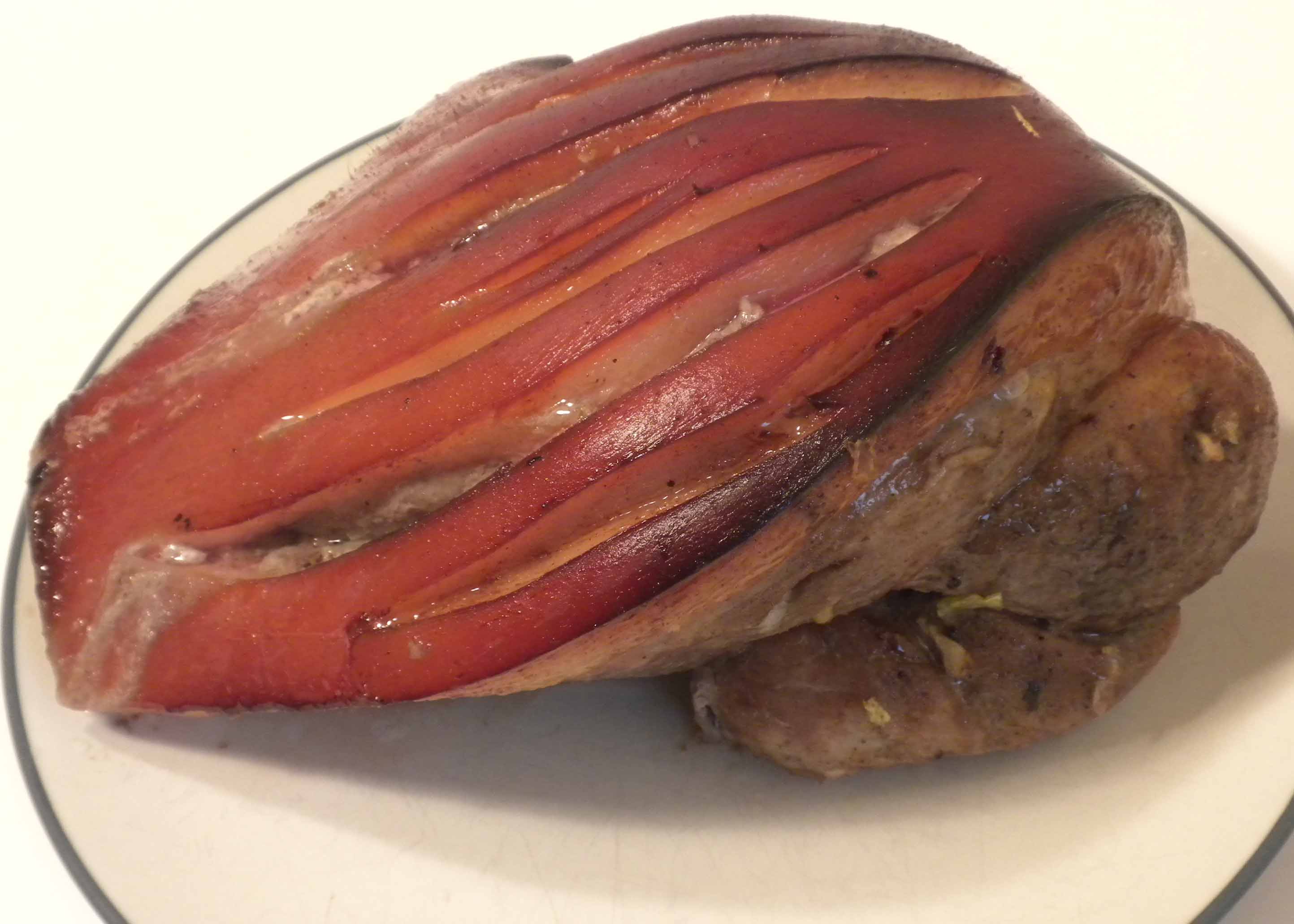
Scored roast pork.
I have often been asked why Tender Grassfed Meat has no recipes for pork. The answer I always give has been the same—conventional pork, even organic pork, is just too lean, lacks flavor, and is always fed a large amount of soy. Soy feeding, in my opinion, will ruin the taste of any meat. These pigs were specially bred to be lean, and have no real flavor. Nearly all the traditional ways of cooking pork were designed for fatter pigs, with every roast having the skin and a thick layer of fat attached. Traditional ways of cooking pork just did not work with the modern pig, a creation of fear, the fear of the fat we need to be healthy.
I knew there were some creative, intrepid farmers who were actually raising pork in the old way, by letting them roam in the forests, letting them root in harvested fields, giving them the skim milk left over from making cream and butter, and giving them table scraps. But I was unable to get any of this fabled pork—until now.
My local farmers’ market now carries real pastured pork. This pork is so much better than anything I was able to get before that it seems like a different species. The meat has incredible flavor, perfect fat content, and makes me feel good after eating it, something that never happened with any other kind of pork.
Real Pork
These pigs are not penned and stuffed with soy and garbage, but roam the woods, eating their natural diet of mast, which is composed of seeds and fruits fallen from trees, various plants, bugs and the occasional small animal. They are also allowed to root in harvested organic vegetable fields and orchards, and are given the skim milk left over from making cream and butter. Even better, these pigs are from the famous Berkshire heritage breed, a breed developed for fine eating in England, long ago.
Interestingly enough, a number of Berkshire pigs are raised in the United States, but almost all of them are exported to Japan, where their meat is called kurobata. But these Berkshires were raised and available locally.
Still better is the fact that these pigs come with a nice coating of their own life-giving fat. In fact, the pork shoulder roasts come with the skin on, and with all the beautiful fat under the skin. This is something I had read about, but almost never seen. Almost all the traditional recipes for pork roasts called for the skin to be left on. Now I would have a chance to taste why pork was so loved in traditional European cooking.
Roasting Real Pork, or Rediscovering the Lost Art of Scoring
I made the first pork roast. I roasted it carefully in a traditional way. I was surprised to see that there was very little fat in the pan. The meat was very good, with a nice flavor, fairly tender, and tasted nothing like the soy-fed pork that I disliked.
But something was missing. It was very good, but not great. Great is my standard for grassfed meat, not good. Good is just not good enough. It is not that I am a great cook—it is that traditional meat does taste great, when properly cooked, and anyone can learn to properly cook grassfed meat. The greatness is in the natural meat humankind has been eating for thousands of years. In other words, the greatness comes from the meat, not the cook. There is a very old saying—“God gives us good meat, the devil sends us cooks.â€
If I cook grassfed meat and it tastes only good, then I know I have done something wrong.
I did a bit of research, and learned about the lost art of scoring. Several old books stated clearly that scoring was the most important part of cooking a pork roast. Most Americans have never even heard of it. The old books assumed everybody would do it as a matter of course.
Scoring means making long parallel cuts through the skin and fat of the pork roast, stopping short of cutting into the meat. Some books advocated making these cuts every quarter inch. I started to score my next roast, and learned that it was not easy to cut through the tough, slippery skin. I sharpened a sturdy knife, got a glove that would give me a good grip, and set to work, being careful to angle the edge of the knife away from the hand holding the pork. This went much easier, though I decided that making cuts every half inch was sufficient.
I roasted the pork the same way I had the previous roast, with the only difference being the scoring. The smell coming from the oven made me so hungry it was hard to wait for the meat to finish cooking. The taste was fantastic, like no pork I had ever tasted before. Very tender, juicy without being wet, rich without being greasy, with a wonderful deep flavor that makes me hungry just to think of it. I now understood why pork roasts were so loved in the past. I felt good and renewed after eating the roast—again a new experience.
And this was a shoulder roast, one of the cheapest parts of the pig!
It is only necessary to score large cuts of pork that have the skin on. Smaller cuts can be delicious without being scored, but trust me on this, a scored pork roast is more than worth all the extra work.
My next book, which will be on barbecuing grassfed meat, will have some wonderful recipes for pastured pork. My thanks to the heroic farmers who are reintroducing real pork to the American people.
This post is part of Real Food Wednesday and Fight Back Friday Blog Carnivals.
Three Steps to Great Lamb
By Stanley A. Fishman, author of Tender Grassfed Meat
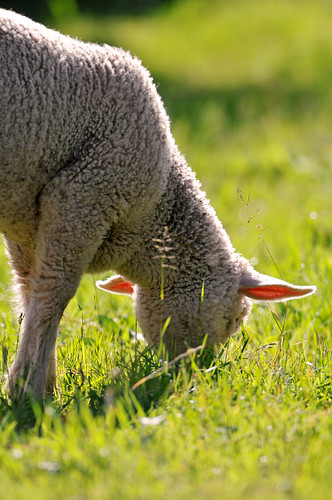
photo credit: Tambako the Jaguar
Lamb is very unpopular in the United States. The amount of lamb in the diet of the average American has declined steadily. When I mention lamb to my friends, most of them say “I don’t like lamb.†This dislike is so intense that most of them will not even taste it.
Yet lamb is extremely popular and valued in all of Europe, the former Soviet Union, the Middle East, India, Australia, South America, New Zealand, in most of the world. In fact, lamb may be the world’s favorite meat.
Why do Americans dislike lamb? Why does the rest of the world love it?
The answer is very simple. The lamb eaten in the rest of the world is very different than most American lamb. There are two major differences.
First, American lamb is usually grain finished, while lamb in the rest of the world is almost always raised exclusively on grass.
Second, American lamb often comes from animals that are also used for wool. Lanolin, a substance present in sheep bred for wool, gives an unpleasant taste and smell to the meat. Most of the lamb eaten in the rest of the world comes from breeds raised for meat, not wool.
Grassfed Lamb Tastes Better
Most American lamb is “finished†on grain, in a feedlot. “Grain†usually means a mixture of GMO corn and GMO soy. This kind of grain is not the natural food of lambs, who are ruminants designed to live on living plants in the pasture, not processed grains.
Most of the lamb eaten in the rest of the world is fed grass only, and is never put in a feedlot.
This is a crucial difference, as the taste of lamb is heavily influenced by what the lamb is fed. For example, lambs raised in central Spain eat a number of herbs in the pasture, which gives a wonderful, herbaceous taste to their meat. Lamb raised in the salt marshes of Brittany is valued for its delicious meat, which has a slightly salty taste, from marsh plants growing in salty soil.
Lamb fed GMO corn and GMO soy has its taste altered by this feed. I consider the taste of such grain fed lamb to be awful.
Grassfed American lamb is wonderful. I have been fortunate enough to get lamb from the Willamette Valley in Oregon. This lamb has a wonderful flavor from some of the richest, greenest grasses in the world.
I have also been fortunate enough to get lamb raised on the Great Plains of the United States, which has grazed on the rich native grasses that were used to nourish the buffalo. The taste of this lamb is also wonderful, though it is different from the Oregon lamb, because the native forage is different.
Grain feeding, in my experience, makes the lamb greasy, with an unpleasant texture. One rancher described this lamb as tasting like “a great, greasy glob of nothing.â€
Grassfed lamb has a sweet, clean taste, redolent with the flavor of the living herbs and grasses eaten on the pasture. It is never greasy, and the texture is firm and tender.
The first step to eating great lamb—buy grassfed and grass finished only.
Lamb Bred for Meat Tastes Better
Humankind has developed many breeds of sheep over thousands of years. Some breeds were developed for their wool, which was used to make clothing. The wool and meat of these breeds contain a great deal of lanolin, a substance that smells bad and gives an unpleasant flavor to meat.
Breeds that have been developed for meat do not have lanolin, and their meat smells good and lacks the unpleasant flavor given by lanolin. Many of these meat breeds have a wonderful flavor and texture of their own, when grassfed.
Unfortunately, much of the lamb sold in the United States comes from breeds that are used both for wool and meat. This is the cause of the unpleasant smell and taste so many Americans associate with lamb.
Meat breeds smell good and taste better.
The second step to eating great lamb is to only buy lamb that was bred for meat, not wool. US Wellness Meats is a great internet source of grassfed lamb from breeds that have been developed for meat.
Traditional Cooking Means Great Lamb
Once you have grassfed and grass finished lamb, from a meat breed, you have to know how to cook it. Lamb is not difficult to prepare, but it is easy to ruin. There are many traditional ways of cooking grassfed lamb that are both easy and wonderful, and a number of them are in my cookbook, Tender Grassfed Meat.
The third step to having great lamb is to learn traditional ways of cooking it.
The Three Steps to Great Lamb:
- Buy only grassfed and grass finished lamb.
- Buy only lamb that is raised for meat.
- Learn how to cook this wonderful meat.
This post is part of Real Food Wednesday Blog Carnival at Kelly the Kitchen Kop.
This post is part of Monday Mania Blog Carnival at the Healthy Home Economist.
Traditional Barbecue Methods Avoid Risk Factors
By Stanley A. Fishman, author of Tender Grassfed Meat
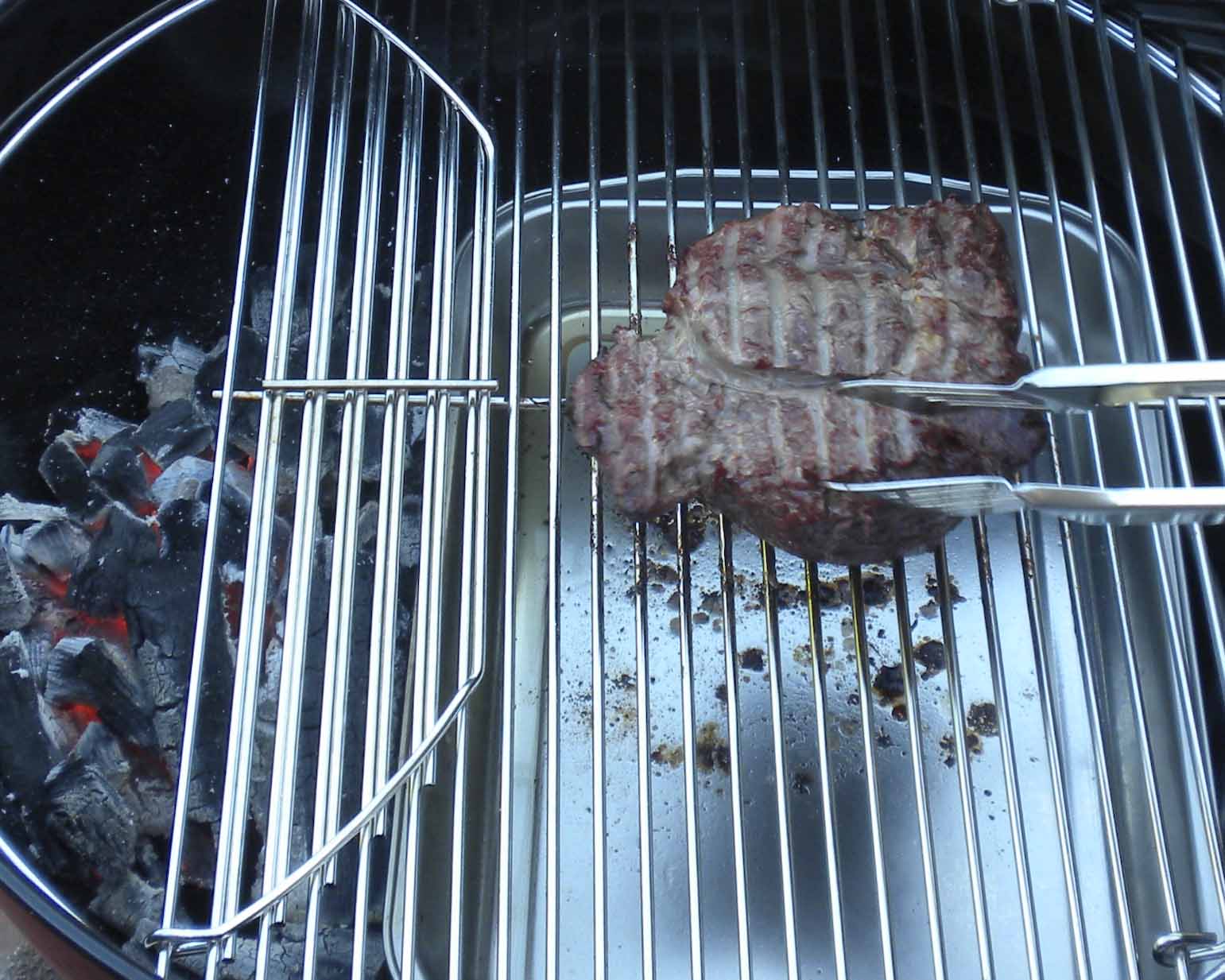
Barbecuing tender grassfed meat with indirect heat.
Is barbecue safe? There are a number of studies that conclude that eating barbecued meat creates carcinogenic substances. However, traditional peoples barbecued constantly and were free of cancer.
The studies all focused on meat grilled with modern methods, using very high direct heat. The traditional methods are very different. No study bothered to contrast the difference between modern grilling methods and traditional methods. In fairness, the researchers were almost certainly unaware of the dramatic difference in cooking methods.
The researchers’ solution is to stop eating barbecue. My solution is to change your cooking method to avoid the risk factors by barbecuing the way our ancestors did.
What the Researchers Found
The studies showed that grilling meat over direct high heat can cause the formation of substances known as HCAs, which are considered carcinogenic when given in large amounts to laboratory animals. HCAs are formed when meat is cooked with very high direct heat, especially when flames hit the meat, and a hard crust is formed by the searing heat.
The studies also found that fat dripping from the meat directly on to the heat source would be changed by the heat, and driven back into the meat as a carcinogenic substance.
What is crucial to understand is that both of these substances are created by grilling the meat directly over a very hot heat source, whether gas or charcoal briquets.
As far as I could tell, the barbecued meat used in the studies was cooked with modern fuels like charcoal briquets and propane gas.
Some researchers found that marinating meat reduced the amount of HCAs by as much as 100%.
How Traditional Barbecue Methods Avoid the Risk Factors
Traditional peoples did not barbecue over direct high heat. In fact, they did not barbecue directly over any heat source, unless the meat was so high over a low fire that there was no chance of flames hitting the meat, and the meat only received low heat.
The prerequisite for forming the carcinogenic substances found by the studies—direct high heat—was never used.
Meat was always cooked in front of, never over, the fire. The fire was always allowed to burn down to smoldering coals—nobody cooked directly over leaping flames. This method did not create hard charred crusts or grill marks, but a delicious, tender, browned coating.
Cooking grassfed meats over direct high heat will make them tough and inedible. Grassfed meats can be very tender when grilled by moderate to low indirect heat, which is how our ancestors grilled them.
Traditional peoples almost always marinated their meat before barbecuing it.
Traditional Peoples Used Different Fuels
Almost all barbecue cooked in the United States today is made over a very hot fire fueled by propane gas or charcoal briquets. Traditional peoples never used these fuels.
Charcoal briquets were invented by Henry Ford as a way to make money from the scrap wood left over from making automobiles. These briquets included many other ingredients besides wood scraps, including anthracite coal, petrochemicals, and various binding materials and chemicals. They were never used by humans before the 20th century, as they were invented in the 20th century.
The use of propane gas as a barbecue fuel also began in the 20th century.
Traditional peoples used various natural substances as fuel. The most common was wood, which was always burned down to coals before the cooking began, or lump hardwood charcoal, which was made by partially burning wood in a way that caused it to form charcoal. The art of charcoal burning goes back thousands of years.
Traditional Barbecue Is Better for Grassfed Meat
Factory meat contains much more water than grassfed meat, which means that it can withstand direct high heat. The most common way to ruin grassfed meat is to cook it over direct high heat. Grassfed meat can be wonderfully tender when cooked with traditional methods.
We can avoid the risk factors identified by the studies by never using direct high heat when barbecuing. We can barbecue like our ancestors did, using lump hardwood charcoal or wood coals for fuel. We can marinate our meat like they did. Not only is this way of cooking safer, it is ideally suited to cooking tender grassfed meat.
This post is part of Real Food Wednesday at Kelly the Kitchen Kop.
This post is part of Fight Back Friday at Food Renegade.
This post is part of Monday Mania Blog Carnival at the Healthy Home Economist.
The Benefits of Organ Meats
By Stanley A. Fishman, author of Tender Grassfed Meat
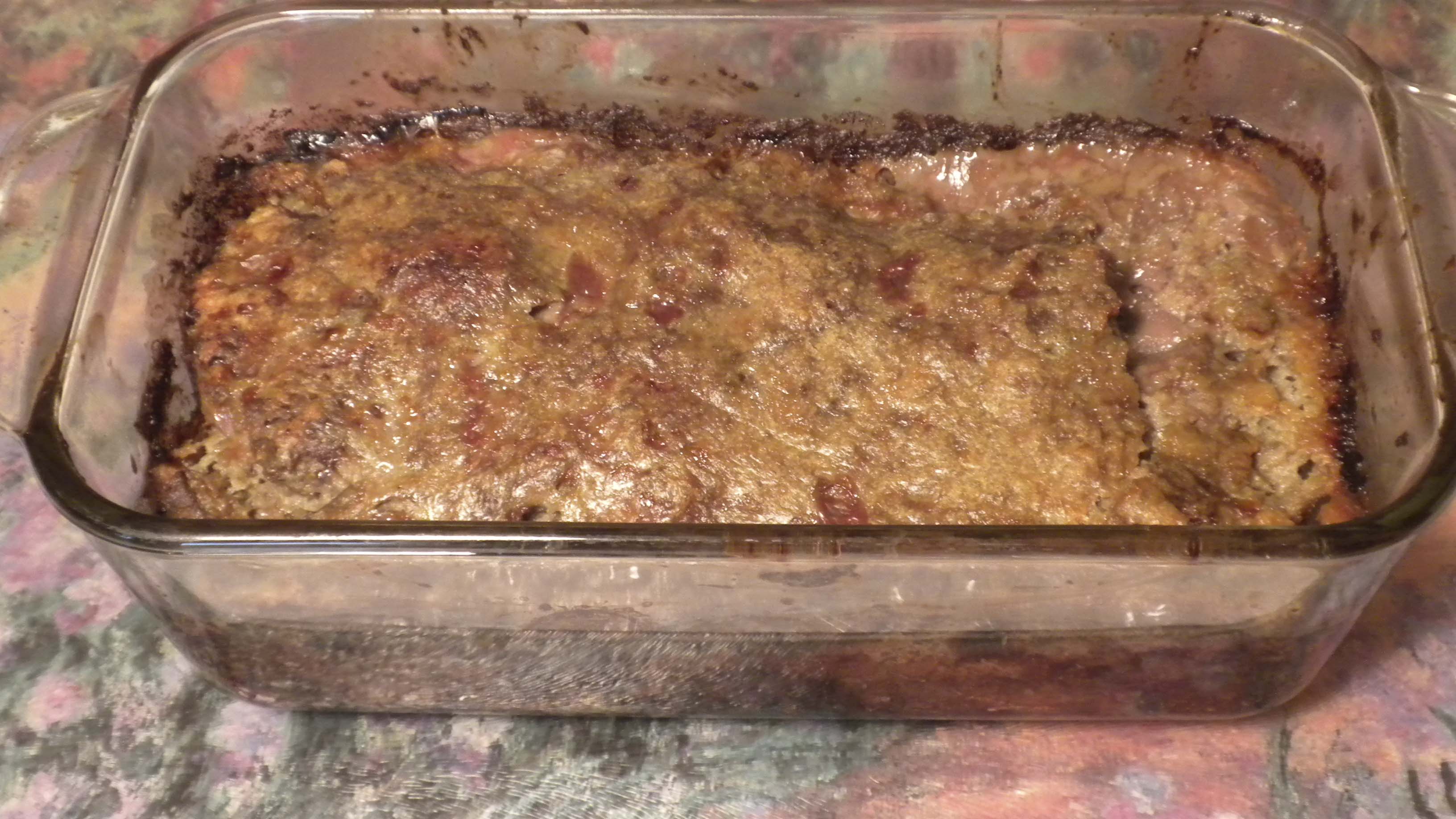
Liverloaf made with US Wellness Meats Grassfed Braunschweiger.
The standard American diet, known as “SAD†(and it is really sad, especially for those who eat it) does not contain any organ meats. In fact, organ meats are demonized for having fat and cholesterol. This is truly a shame, because organ meats from grassfed animals are one of the most nutrient-dense foods available, being packed with vitamins, minerals, amino acids, and other nutrients.
Our ancestors knew the value of organ meats. They gave great value to liver, heart, and kidney, and used these foods to support the health of their own organs. We can do the same.
Organ Meats Were Crucial in Traditional Diets
When I did the research for Tender Grassfed Meat: Traditional Ways to Cook Healthy Meat, I read a number of old cookbooks. I was astonished to find literally hundreds of recipes for all kinds of organ meats. Liver was considered a staple of the diet, and was sautéed, made into dumplings and pastries, eaten raw, puréed, roasted, and minced. When hunters killed an animal, it was a tradition to eat the warm liver on the spot, raw, with everyone in the hunting party having a share. This was not only a tradition among European hunters, but was also done by the Native Americans, and other people all over the world. Even predators such as lions, bears, and tigers will eat the liver first. There are hundreds of traditional European sausages made from liver, liverwurst being just one of them. Pâtés are one of the tastiest results of this tradition.
There were a myriad of recipes containing kidneys, heart, brains, sweetbreads (thymus gland), intestines, even lungs, spleens, and other organs. These organs were also made into sausages, pies, soups, fritters, and preparations unique to each organ. It was also traditional to stuff the stomach of an animal with chopped organ meat and other foods, the famous Scottish Haggis being an example of this. Most of these recipes were a great deal of work, because most organ meats require a great deal of trimming. There are often membranes, veins, arteries, and other inedible parts that must be removed, and the edible portions often required soaking, often multiple soakings, pounding, and intense cleaning. These recipes would often go into great detail as to how to prepare the organ meats for cooking.
The healthy peoples studied by Dr. Weston A. Price all ate organ meats, and valued them highly. Their traditional preparations of these meats also involved a great deal of work in cleaning and preparing the organs.
It should be noted that many of these dishes did not taste particularly good, and were resisted by children. People ate them anyway, and forced their children to eat them.
Why did all of these traditional peoples go to all that work and trouble? Because they knew there was something in these organ meats that was good for them, and because this knowledge had been handed down from generation to generation.
The Traditional Use of Organ Meats to Support Organ Functioning
Many traditional peoples, including the Native Americans, and even the pre-drug medical profession, believed that eating the organs from a healthy animal would support the organs of the eater. A traditional way to treat a person with a weak heart was to have the person eat the heart of a healthy animal. There were a number of country doctors who reported success with using this method. Eating the brains of a healthy animal was also believed to support clear thinking. People with bladder and kidney problems would be fed kidney meat from healthy animals. Native Americans with a vision problem or eye injury would be given the eyes of animals to eat. There are many reports confirming the success of such practices. In modern times, a number of people who need thyroid hormones have eaten the thyroids of animals, as an effective alternative to thyroid medication. However, I do not recommend that anybody do this on their own, without the supervision of a qualified medical professional. Nevertheless, many people have reported success with this practice.
Liver was often given to sick people, as the huge amounts of quality nutrients in this organ helped rebuild their bodies. Great emphasis was placed on only eating the organs from healthy animals.
However, most of the organ meats were eaten as part of the regular diet, by healthy people whose culture knew that eating these organs would support the natural functioning of their bodies. That is why they went through all the work necessary to prepare them.
Science Has Confirmed the Nutritional Benefits of Organ Meats
The development of the ability to identify and test for the presence of nutrients has confirmed what most people already knew—organ meats are a nutritional powerhouse, full of vitamins, minerals, amino acids, and many other substances vital for nutrition. Liver in particular is crammed full of vital nutrients, which is why predatory animals eat it first, and why it has been so valued over the course of time.
Unfortunately, organ meats have been demonized because they contain fat and cholesterol, and most people are afraid to eat them. The cholesterol myth is just that, a myth, and the fat of healthy animals is beneficial for human health, as shown in these articles: Know Your Fats Introduction and Cholesterol: Friend or Foe?
The organ meats eaten by our ancestors and traditional peoples have great nutritional value.
An Easy Way to Eat Organ Meats
We can get the benefits of organ meats, even today. I do not recommend eating the organs of factory animals. The organ meat of factory animals is not the same meat that has been eaten for thousands of years, but is different, as the animals have usually been given hormones and antibiotics, and have not been fed their natural feed. My personal choice is to eat the organs of grassfed and grass finished animals only. In the case of omnivorous animals such as pigs and chickens, I choose to only eat the organs of pastured animals.
But I will confess that all the preparatory work that is necessary for enjoying most organ meats is more than I want to do. I will buy organ meats that come ready to cook, but my favorite way to eat organs is by eating organ sausages.
Great care must be taken in choosing sausage, because all kinds of undesirable ingredients are often added to them. I insist on knowing everything that is in a sausage before I eat it. Currently, I know of only one Internet source for grassfed organ sausage that has no undesirable ingredients. These sausages are of the highest quality, and I eat them at least once a week. These are the organ sausages made and sold by US Wellness Meats. They make a delicious liverwurst that contains liver, heart, and kidney. They make two kinds of braunschweiger that contain a lot of liver: one cooked, and the other one raw. They also sell a headcheese that contains tongue and heart. These sausages can be made into delicious recipes. Here is a link to a recipe I created for the raw braunschweiger: liverloaf. There are also recipes using these sausages on pages 179-182 of Tender Grassfed Meat.
Organ meats are some of the most vital and nutrient-dense foods available to us. Our ancestors knew this, and we can learn from them.
This post is part of Real Food Wednesday Blog Carnival at Kelly the Kitchen Kop.
This post is part of Fight Back Friday Blog Carnival at Food Renegade.
This post is part of Monday Mania Blog Carnival at the Healthy Home Economist.
Don’t Trim the Fat—It’s the Best Part!
By Stanley A. Fishman, author of Tender Grassfed Meat
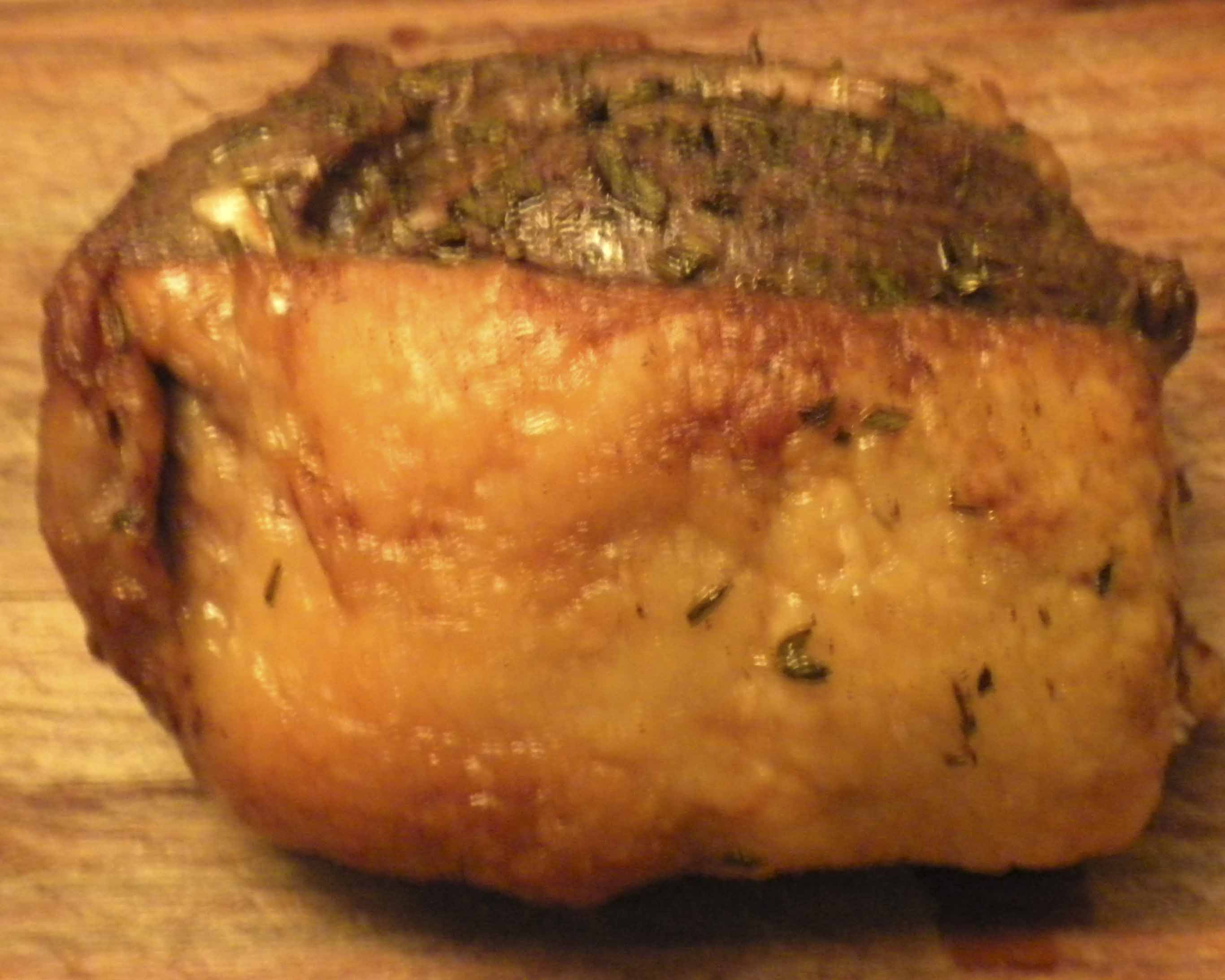
This beautiful fat cap helps make a wonderful herb roast.
The half chicken arrived on my friend’s plate, with a wonderful aroma. It was grilled over hickory to browned perfection, the crisp skin redolent with a wonderful spice rub that promised taste heaven. My friend picked up his knife and fork, carefully removed every trace of the magnificent chicken skin—and discarded it.
The prime rib roast looked great on the website photo. The meat was a beautiful cherry red color, crowned by a thick cap of gleaming fat that promised great taste and nutrition. I ordered this magnificent roast, anticipating how wonderful it would look and taste. The roast arrived. Every bit of the magnificent fat cap promised by the photo on the website had been trimmed off.
I ordered a cut-to-order bison Porterhouse for a very important occasion. I made sure to instruct the seller to leave a thick coating of the bison fat on the meat, as bison fat gives incredible flavor. The steak arrived. It was a magnificent piece of meat—except that almost all the fat was trimmed off.
Each of these events point out one of the most insane aspects to our society. We have been trained to discard and throw out one of the most nutritious substances known to humankind—saturated fat from grassfed animals.
Saturated fat from grassfed animals should not be trimmed off and discarded. It should be used in cooking and eaten, just as humankind has been doing for hundreds of thousands of years.
Animal Fat Has Been Unfairly Demonized for Profit
Why does almost everybody fear saturated animal fat? The answer is simple—marketing. The sellers of artificial fats and artificial oils would have no market if people continued to use saturated animal fats that have nourished humankind for eons. The only way to get people to give up these tasty and wonderful foods would be to either come up with something better, or make people afraid to use them. They could not come up with any artificial food that was better or even close to being as good as those developed by nature. This left fear. Adolph Hitler said that if you repeated a lie often enough, and loudly enough, and repeated it with enough fervor, people would come to believe it.
It would be hard to find any concept that has been repeated as much, or stated so loudly, or advocated with such fervor as the “saturated fat is bad†untruth. The truth is that saturated animal fat from naturally fed animals is one of the most beneficial nutrients know. See the following article for more information: Know Your Fats Introduction. A good description of how America was misled is contained in the article The Oiling of America.
Saturated Animal Fat Supports the Natural Functions of the Brain and Body
Your brain is made of fat. So is mine. So is everybody’s. The right kind of fat is crucial to the proper functioning of the brain. A deficiency in fat can lead to mental and physical problems. The right kind of fat is—saturated animal fat. This fat, especially the fat from grassfed animals, contains a huge amount of vital nutrients. Animal fat, including the fat found in organ meats, is the only source of real Vitamin A. (Plants have beta carotene, which is not Vitamin A, but a precursor that a healthy body can use to make vitamin A.) Animal fat is by far the best source of essential fatty acids, which are crucial for nutritional support of the brain and many body functions. Animal fat contains substances that effect digestion, blood sugar, regulate the body’s production of hormones, enable the various parts of the brain to communicate effectively with each other, regulate the weight and metabolism of the body, and provide high-quality energy fuel that our bodies have been using for hundreds of thousands of years. Our bodies and brains are unbelievably complex organisms that are able to deal with almost any physical or mental challenge that is likely to arrive—if they have the nutritional fuel needed to function properly. This fuel includes saturated animal fats. A more detailed examination of the benefits of saturated animal fat can be found in this fine article: The Skinny on Fats.
Traditional Peoples Knew the Value of Saturated Fat
Dr. Weston A. Price spent ten years studying the diets of traditional peoples. The healthy peoples he studied were free of the chronic diseases that ravage our “civilized†world—such as cancer, heart disease, allergies, infertility, asthma, birth defects, etc—as long as they ate their traditional diet. These traditional diets contained far more nutrients than ours. While there was a lot of variety in these diets, all of them included a huge amount of saturated animal and/or fish fat.
This fat, from animals eating their natural diet, has been perhaps the most valued food in the history of humankind. People, from ancient Rome to 19th century Russia, used to write poems celebrating the blessings of animal fats. When animals were sacrificed to the pagan gods, the most valued part of the animal—the fat—was offered. Many peoples had a tradition of having a lot of food after a funeral. Whether it was the Jewish custom of sitting Shiva, or the Irish custom of having a wake, or any of the others, foods high in animal fat were always served. These traditional people knew that these foods would calm the mind and help people deal with their grief. “Living off the fat of the land†was a famous saying that meant living the good life. Modern science has discovered many of the benefits of this most valued food: Some Recent Studies on Fats.
Animal Fat Is Wonderful in Cooking
Meat roasted with a covering of its own natural fat is far more tender and delicious. The fat bastes and cooks into the meat during the roasting process, keeping it tender, and adding superb flavor. Pot roasts and stews also have their flavor and gravies enhanced by this wonderful fat. Sausages and ground meat are much better, both in taste and nutrition, when they contain a healthy portion of life-giving animal fat. Steaks cooked with a rim of their own natural fat are more tender and have superb flavor. In fact, it is commonly accepted in cooking circles that most of the flavor of meat is in the fat.
Traditional peoples cooked with animal fat, with natural pork lard being the most widely used and popular cooking fat in human history. Lamb fat, beef tallow, bison fat, chicken fat, in fact, fat from every kind of meat animal, were also widely used.
I personally use saturated animal fat for cooking grassfed meats. Whether it is beef tallow, or butter, or natural lard, or duck fat, all of them are perfect for frying, basting and sautéing. But nothing can do more for the flavor and tenderness of cooking meat than its own natural coating of flavorful fat.
So I have a favor to ask from meat sellers, butchers, ranchers, and retailers – don’t trim all the fat off. Leave at least one quarter inch on the meat. Just one quarter inch. That’s all I ask.
This post is part of Real Food Wednesday Blog Carnival at Kelly the Kitchen Kop.
This post is part of Fight Back Friday Blog Carnival at Food Renegade.
This post is part of Monday Mania Blog Carnival at the Healthy Home Economist.
The Blessings of Bread and Butter
By Stanley A. Fishman, author of Tender Grassfed Meat
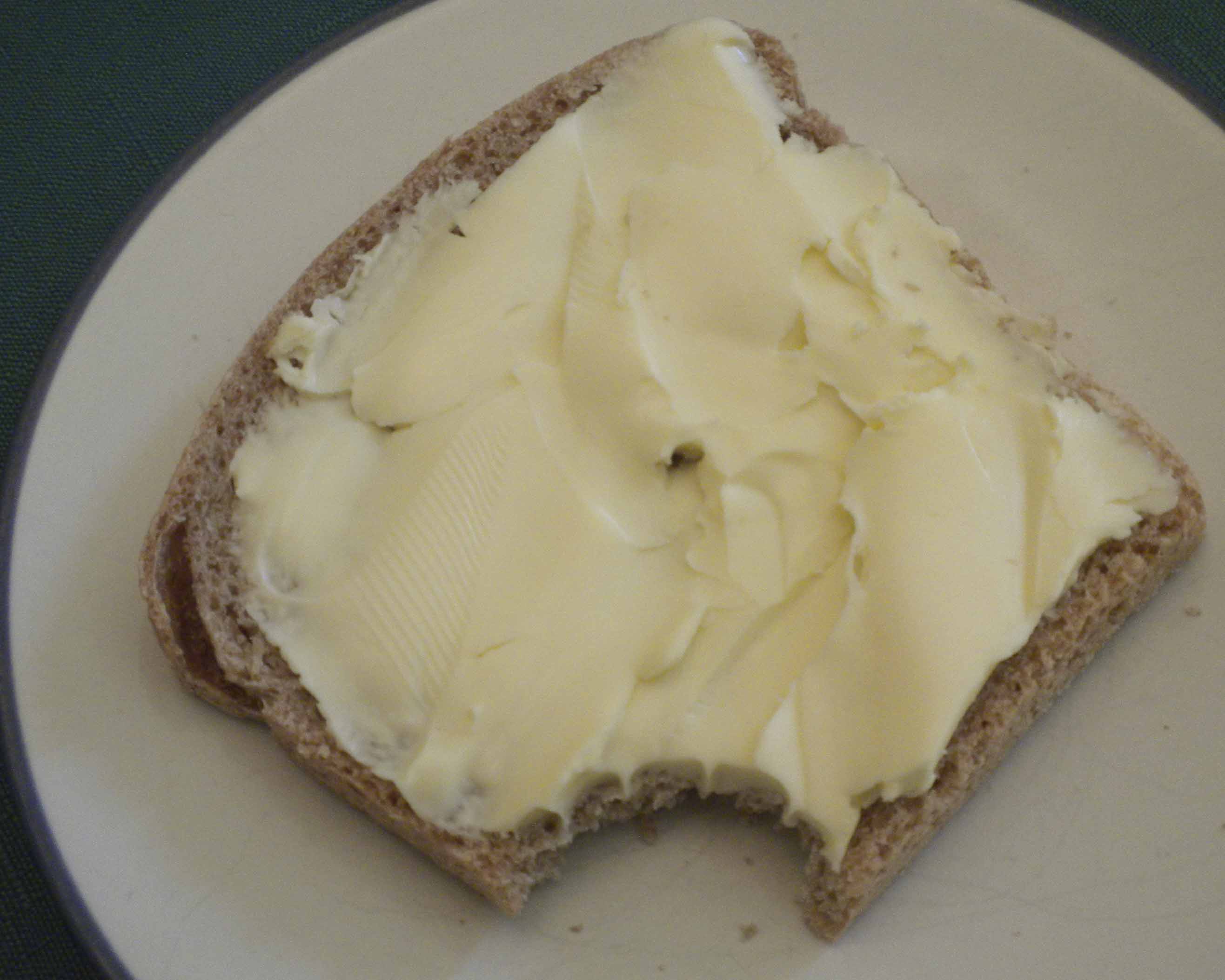
Toothmarks show that this is the right amount of butter, as inspired by Sally Fallon Morell.
Bread and butter were so traditional in Europe that they were usually served at every meal. In fact, the expression “bread and butter†meant something solid, valuable, and indispensible. Both bread and butter have fallen into disrepute recently, and are rarely eaten in their traditional forms. This is a pity, because bread and butter in their traditional forms were incredibly nourishing and formed the indispensible basis for every meal.
What Happened to Bread and Butter?
Butter in its traditional form was one of the most nourishing foods known in Europe. But butter was demonized in the United States and then the rest of the world. The reason for this was simple—the makers of artificial fats and margarine had a product that was totally inferior to butter, both in taste and nutrition. These artificial foods were not initially welcomed by the public, who preferred the traditional fats that had nourished their ancestors for thousands of years.
The manufacturers of the first artificial fats had a real problem. Their products were so inferior in taste and nutrition, that nobody who could afford real fats would ever buy them. Unfortunately, the manufacturers came up with a marketing strategy that is still heavily in use today. The strategy had two major points. The first was to claim that traditional fats like butter, which had been known to be the most nourishing and valued of foods, actually caused heart disease and other illnesses. This was blatantly untrue, but intensive marketing campaigns and questionable “research†convinced the public that butter and other traditional animal fats were unhealthy. The second focus of the marketing campaign was to claim that artificial fats were “more scientific†and healthier. This is also untrue, as shown in the article “The Skinny on Fats.â€
Bread used to be made from sprouted grains and/or by a sourdough process. Both of these methods neutralized the antinutrient substances contained in grain and caused the bread to be more slowly digested, which helped to avoid insulin problems caused by an overload of carbohydrates. This traditional bread became very rare, and was replaced by modern versions that were made with heavily refined flour. The grain was no longer sprouted. People were eating a type of bread that they had never eaten before.
The Tradition of Bread and Butter
Traditionally, bread was always eaten with plenty of butter. The two foods complemented each other. The butter facilitated metabolism, digestion, and the ability of the body to absorb nutrients. This butter was always made from the whole, unprocessed milk of grassfed cows, and was loaded with all kinds of vitamins, minerals, and a very special nutrient that Dr. Weston A. Price referred to as “Activator X.†The bread, made from sprouted grains, and often fermented by traditional sourdough methods, contained important nutrients, and provided a perfect vehicle for the butter. Just about every traditional European cuisine began each meal with this kind of bread and butter, which was considered absolutely essential for good health and digestion.
Dr. Price and the Swiss
Dr. Weston A. Price studied the diets of traditional peoples who were noted for their lack of chronic illness and robust good health. One of the peoples he studied lived in a rural area of Switzerland. These people ate superb grassfed butter slathered on traditionally made rye bread. Dr. Price studied the butter eaten by these people, sending samples to the United States to be analyzed. He found that this butter had an undiscovered nutrient which he called “Activator X.†Dr. Price’s research showed that people who had a plentiful supply of Activator X were much healthier than those who did not. The best source of Activator X in traditional European diets was butter. No wonder just about every European people would traditionally eat bread and butter at every meal.
How to Follow the Old Wisdom of Bread and Butter
If you want to enjoy the traditional blessings of bread and butter, it is crucial to have the right kind of bread and butter. The modern factory versions are not what our ancestors ate and are different substances.
The very best butter comes from cows who have been traditionally raised on green growing grass. Their butter is at its very best when they have been eating green, living grass, and traditional peoples timed their butter making to take advantage of the season when this grass was available. Butter like this is available today, but you have to make an effort to find it. Some local farmers make this kind of butter. Some nationally available brands that I have enjoyed are: Pastureland (sold by US Wellness); Trader Joe’s Organic Sweet Cream Butter (salted); and Kerrygold.
Traditional breads are made from sprouted grains and/or traditional sourdough methods, from grain that has not been sprayed with chemicals.
The Weston A. Price Foundation has done a wonderful job of identifying the right kind of bread and butter to eat. The best source that I have found for making traditional bread is Sally Fallon Morell’s magnificent cookbook, Nourishing Traditions. I have achieved wonderful results from To Your Health Sprouted Flour.
It is crucial that the right amount of butter is used on the bread. Most people have been trained to put a thin, pitiful, stain-like smear of butter on their bread, on the rare occasions when they allow themselves butter. The proper amount of butter to use is shown in the photo above, which was inspired a statement by Sally Fallon Morell that there should be enough butter on the bread to show toothmarks in the butter.
What does bread and butter have to do with grassfed meat? Traditionally, bread and butter were always served before the meat in Europe, and provided a wonderful appetizer that helped prepare the body to absorb the wonderful nutrients in grassfed meat.
Disclaimer: I do receive a very small amount of compensation if you buy Nourishing Traditions through this website. I do not receive any compensation if you buy any of the other brands mentioned in this article.
This post is part of Real Food Wednesday Blog Carnival at Kelly the Kitchen Kop.
This post is part of Fight Back Friday Blog Carnival at Food Renegade.
Understanding Dr. Weston A. Price
By Stanley A. Fishman, author of Tender Grassfed Meat
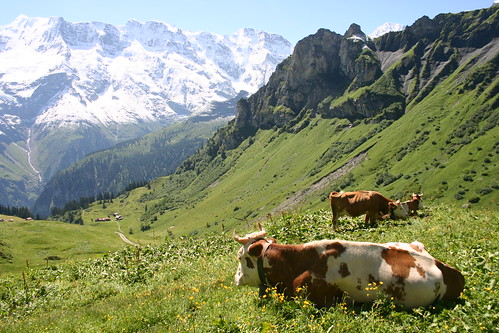
photo credit: TAYLOR149
“Life in all its fullness is nature’s laws obeyed.†Dr. Weston A. Price.
I have seen these words many times, but I did not really understand them. Until now.
I have been very ill for most of my life. I have had a lot of medical treatment. Most treatments would relieve the symptoms, for a while, than the symptoms would return, worse than ever.
Yet when I followed the Weston A. Price diet, did what I could to avoid toxins, switched to grassfed meat, and had no medical care, all my symptoms went away, and they did not return. And my body functions began to improve, and they are still improving. At 58.
Many body functions that did not work, such as having a sense of smell, being able to breathe through my nose, breathe effortlessly, and sleeping through the night, returned. Other body functions that had been deteriorating such as hearing, eyesight, digestion, sense of touch, taste, and flexibility, are now improving. My mental attitude also improved enormously. I began waking up with a sense of joy and eagerness to live the day, a feeling I last had when I was a child. My usual mental feeling could best be described as a happy, peaceful contentment.
What happened?
Modern Medicine
Modern medicine is focused on treating a particular disease, defined by a set of symptoms. These days, the disease is treated with artificial medication, or surgery, or radiation, or all three. All of these treatments are a massive and powerful assault on the body and its natural systems, often doing great harm. Success is defined by a cessation of the symptoms. Usually, the symptoms return in the future, worse than before, and the cycle begins again.
Nature’s Laws
We all have an immune system, and other bodily functions that are designed to fight off disease and keep us healthy and regenerating. Modern science and medicine arrogantly claim to know how they work, but this knowledge is still incomplete. They just know the tip of the iceberg. This iceberg is powerful and complex beyond our understanding.
We have a powerful desire to eat, and eat food that will satisfy us. We are born with it.
The healthy peoples studied by Dr. Weston A. Price did not have the chronic diseases that plague modern humanity. They did not have scientists, or laboratories. They did not have doctors or dentists, though they had healers. They knew far less about the tip of the iceberg than we do. But they knew something very important. They knew how to feed the body, the whole body. And the body sustained and protected them, just as nature intended.
These peoples did not have peer-reviewed studies, or computers, but they had something else. The accumulated experience of thousands of years of living, passed down from mother to daughter, from father to son, from healer to healer, from wise person to wise person. This priceless knowledge was based on the combined experience of tens of thousands, even millions of the ancestors of their people, who paid careful attention to their own observations, filtered through the wisdom of common sense, and passed on this knowledge.
The healthy peoples studied by Dr. Price knew what to eat, and what not to eat. They knew how to prepare food. They knew how to combine food. They knew how to preserve food, though they had no refrigerators. They knew how to satisfy their hunger, with the right foods, properly prepared. They did not decide what the laws of nature were, they discovered them. They knew how to avoid the natural toxins and dangers in their land. They obeyed the laws of nature, and were rewarded.
I think modern people have lost most of this knowledge, and no longer know how to obey nature’s laws. We have tried to substitute the incomplete knowledge of science and technology for the laws of nature, to make our own laws. And we have suffered terribly for this, as shown by the huge and increasing amount of chronic illness in the most “advanced†nations.
Science and technology have accomplished wonderful things in many areas, and have greatly improved life. But their knowledge in the area of nutrition and health is partial and incomplete. I support real research, research based on the desire to learn and share, rather than the desire to exploit. But much of this research has not been completed.
What happened to me?
I think my body’s functions were supported and activated. I think that the changes I made enabled my body’s systems to function the way nature intended them to. I think the avoidance of toxins reduced the burden on my body’s systems, enabling them to function better. I think that following the Weston A. Price diet, eating traditional foods, and eating traditional food combinations gave my body’s systems the fuel and resources they needed to function properly.
I don’t know how to cure, prevent, or mitigate any disease. But following the old wisdom discovered by Dr. Price has allowed me to follow nature’s laws, which has enabled my body to function properly. And I enjoy the fullness of life.
For more information about Dr. Weston A. Price, please visit these websites: The Weston A. Price Foundation and Price-Pottenger Nutrition Foundation.
This post is part of Real Food Wednesday Blog Carnival at Kelly the Kitchen Kop.
This post is also part of Fight Back Friday Blog Carnival at Food Renegade.
A New Podcast Interview about Grassfed Meat
By Stanley A. Fishman, author of Tender Grassfed Meat
 Real Food Media blogger Ann Marie Michaels, also known as Cheeseslave, has done a podcast interview with me. Ann Marie is an expert on real food, and it was an honor to be interviewed by her. We covered a number of issues concerning grassfed meat: why it must be cooked differently from factory meat; how I learned how to cook grassfed meat; some barbecue tips for July the Fourth; why grassfed meat is sustainable and better for the planet; how it differs from conventional meat; how grassfed meat is so nutrient-dense and satisfying; the benefits I received from eating grassfed meat; how traditional food combinations provide complete and superior nutrition; even what to add to US Wellness liverwurst to make it into a spreadable pate; and more!
I found Ann Marie’s questions and comments to be insightful and invaluable, and I really learned a lot during this interview, which I greatly enjoyed. Ann Marie has been spreading the word about real food for some time now, and I highly recommend her blog.
Here’s the link to the podcast:
New Podcast: Stanley Fishman Talks About Tender Grassfed Meat
Multiple Meals from the Traditional Sunday Roast
By Stanley A. Fishman, author of Tender Grassfed Meat
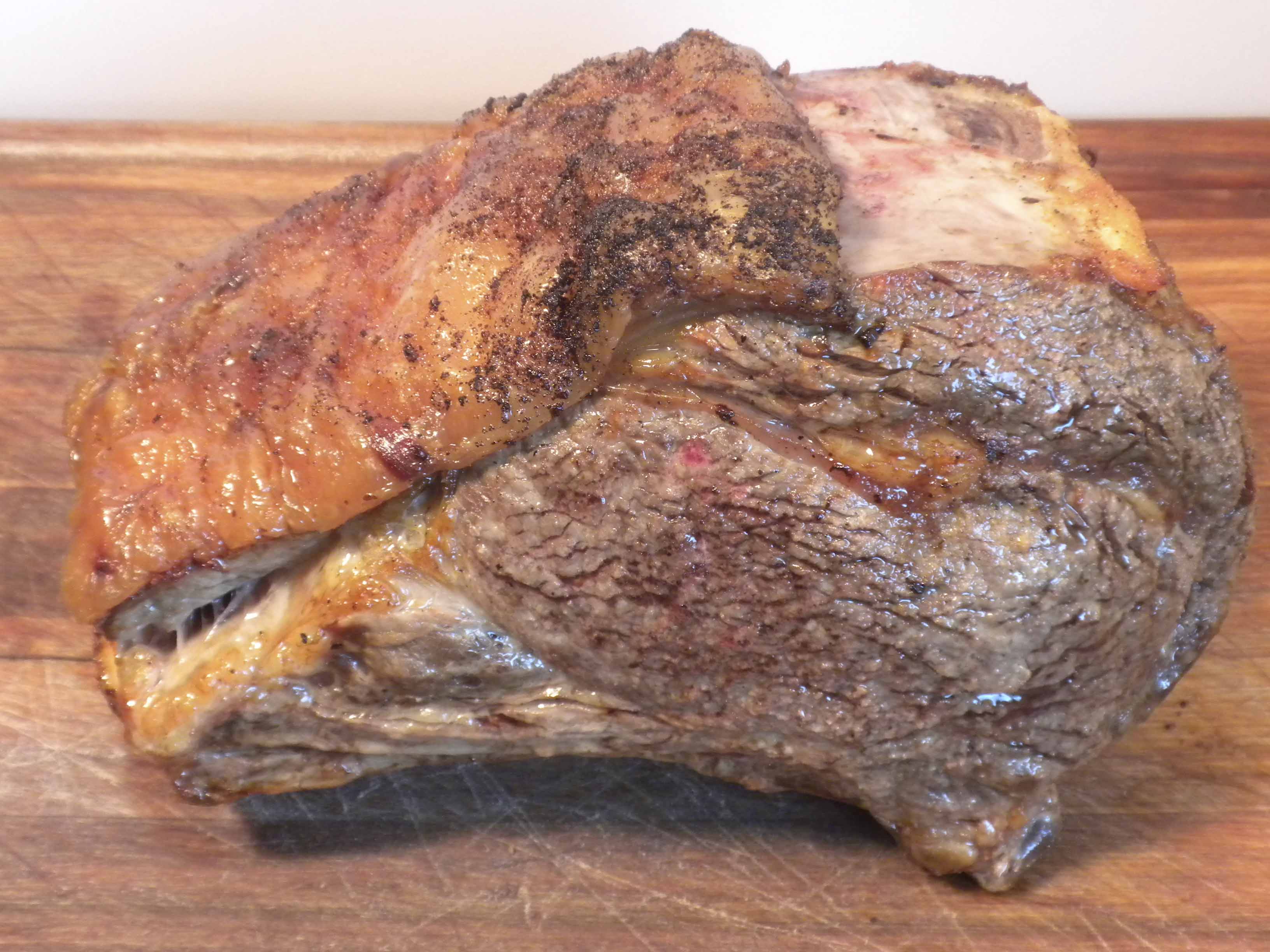
English Style Prime Rib, recipe on page 86, Tender Grassfed Meat
Once it was traditional for even a middle class family to have a large roast on Sunday. This was the main meal of the week, and was eagerly anticipated. This tradition was very popular in England, Ireland, and the United States. The attraction of a large roast of tender, juicy, delicious meat is obvious. But what is not so obvious is that the leftover meat could provide several additional great meals.
One Roast, Four Meals
Using the leftovers from the Sunday roast for other meals became so much of a tradition in England that there was even some verse on the subject – “Roast on Sunday, Cold on Monday, Chopped on Tuesday, Pie (Shepherd’s) on Wednesday.†The tradition of having several meals from one roast has been reinstituted in my family, but we have found tastier choices than cold, chopped, or pie. It really is a money saver to have one roast provide four meals, and we do it whenever we have a large roast. The additional meals we cook surely do not taste like “leftoversâ€â€”they are just delicious.
The European Tradition—Twice Cooking Meat
Meat was far too expensive to waste in old Europe, so the Europeans developed a number of ways of reheating cooked meat into a delicious new meal. In fact, many old cookbooks suggest that a pot roast is at its best reheated, not fresh. These books actually advocate cooking a pot roast on one day, letting it sit overnight, then slicing it and reheating the slices in the gravy. Cooked meat can develop even more depth of flavor and become more tender when it rests in the refrigerator. One of the most famous examples of this tradition is Bigos, which is considered by many to be the Polish national dish. Bigos is a combination of pork, sausage, mushrooms, sauerkraut, fresh cabbage, and many other ingredients. It was reheated each day, and was said to reach its peak flavor on the seventh day. The point is that leftovers can be turned into delicious meals.
What Roast to Use?
The favorite cut for the Sunday roast was, without question, prime rib of beef. This is a truly magnificent roast. Crowned with a superb cap of flavorful fat, resting on a natural rack of beef ribs, tender and juicy, possessing a unique flavor of its own, this is truly a special roast. Alas, nowadays, it is truly an expensive roast, one for special occasions. The Sunday roast we usually have is a nice piece of center cut shoulder (also known as cross rib, or shoulder clod). This cut is far less expensive. In fact, center cut shoulder is usually relegated to the crock pot by most grassfed websites and producers.
I have learned how to make tender, terrific roasts out of this very economical cut. My cookbook, Tender Grassfed Meat, has no less than eleven delicious recipes for roasting center cut shoulder in the oven. Grassfed center cut shoulder usually has most or all of the fat trimmed off, but I have found ways to compensate for this, which are covered in the recipes. Properly roasted, this cut makes a wonderful roast, often so tender that you can literally cut it with a fork.
“Tastes Too Good to Be Leftovers†Meals
After we have eaten our fill of the Sunday roast, there is a lot of leftover meat because grassfed meat is so satisfying. I will divide the leftover meat into two unequal portions. The largest portion, in one piece, is destined to become pot roast. The smaller portion, the rarest quarter of the leftover meat, will be turned into a stir-fry or hash. Tender Grassfed Meat has five recipes for pot roast, and I have made all of them successfully with leftover roast. That is one additional meal. We always have leftover pot roast, and that is refrigerated overnight, sliced, and reheated slowly in the flavorful leftover gravy, in the old tradition. That is another additional meal. Finally, we will usually stir-fry the reserved meat with various vegetables, using one of the three stir-fry recipes in Tender Grassfed Meat, which gives us our third additional meal.
Following the old tradition of getting several meals from the Sunday roast has really helped us get more delicious meals from one piece of meat.
This post is part of Real Food Wednesday Blog Carnival at Kelly the Kitchen Kop.
« Previous Page — Next Page »